Leading From the Second Chair
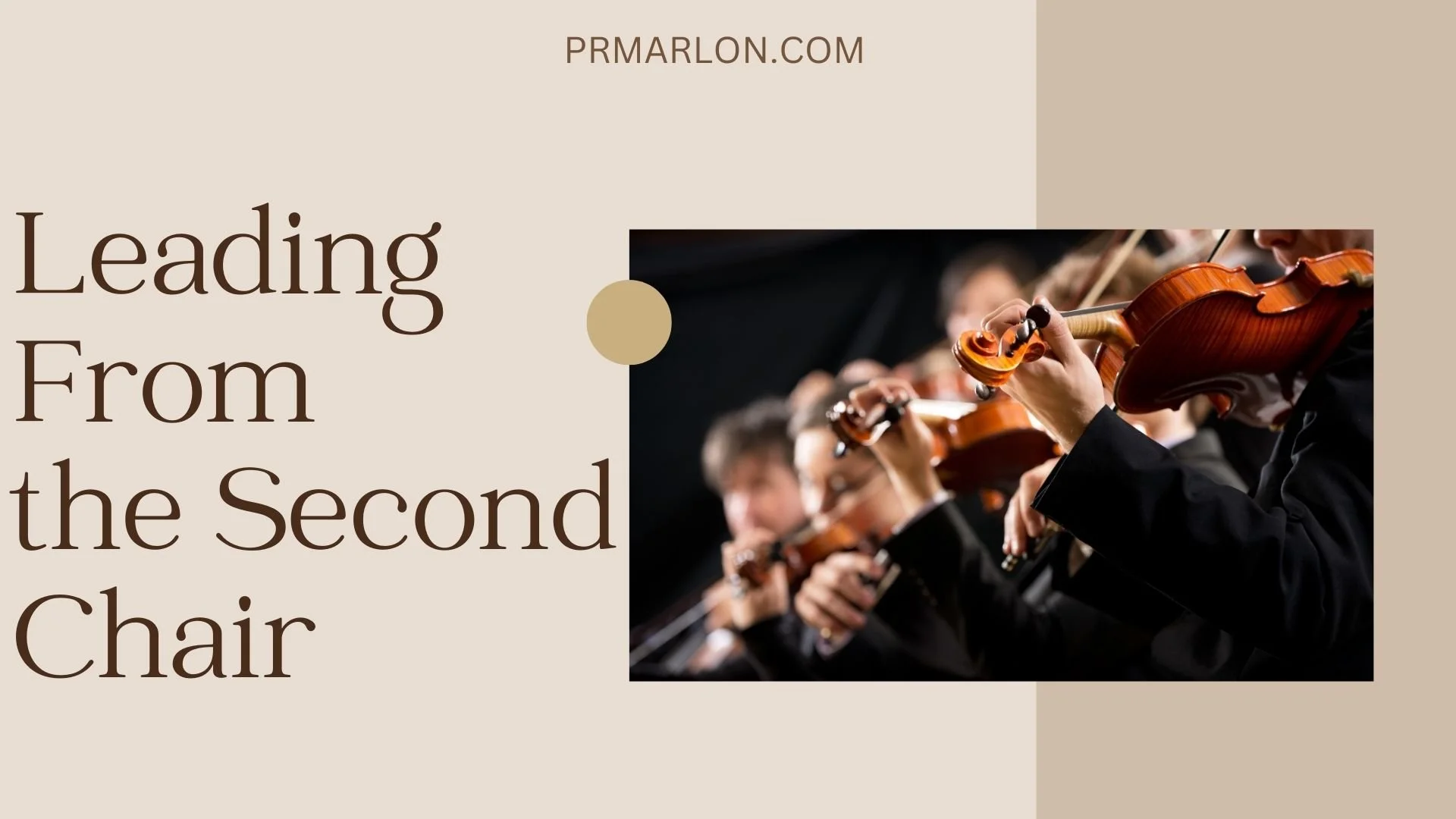
From 7th grade through college, I played in string and symphony orchestras. I still have my violin, which my daughter recently began playing. I am grateful for all the experiences I had playing with the orchestra, but to be completely honest, I was never very good. I did not practice as much as I should, and to be honest, I was okay with that. I just wanted to be good enough to be in the orchestra. I put in enough effort not to let my friends down, but I never wanted to be the best, or even among the best.
If you’re not familiar with how orchestras are organized, or at least the violin section, the audition and the seating are based on skill level. The worst player will be in the second chair of the last stand of the second violin section, and the best violinist of the orchestra sits in the first chair of the first stand, and is often considered the concertmaster, and leads the orchestra in the absence of the conductor.
The highest I ever reached was first chair on the first stand of the violin section of my high school string orchestra, in my senior year, when all other senior violinists were in the first violin section. At the university, I auditioned and barely made it into the symphony orchestra. I was second chair of the last stand for my first year. But I made it! I eventually moved up a bit, but never made it to the first violin section.
I was not the best violinist in the orchestra by a long shot. But I was so grateful to have the opportunity to play in the university’s symphony orchestra that I often asked our conductor how I could help. Either setting up, tearing down, or taking on tasks others preferred to avoid. If I could not add much value to the orchestra as a violinist, I was determined to find other ways to add value and earn my place among that fantastic group of musicians.
That drive to contribute opened my eyes to the fact that, although I could not make the type of contributions a concertmaster could (I lacked both the skill and knowledge to do so), I could still contribute to the group in other ways. I was happy to tag along, go on tours, and make beautiful music. Playing in the orchestra, I learned that I didn’t need a title or be the designated leader to make a valuable contribution. You don’t need to be the best to be a part of the community.
The story of Abigail is a great example of exceptional leadership skills displayed by an unlikely leader. Let’s dive in and see what we learn.
Leading in a Time of Crisis: Abigail’s Bold Decision
Historical Context
Then Samuel died; and the Israelites gathered together and lamented for him, and buried him at his home in Ramah. And David arose and went down to the Wilderness of Paran.
— 1 Samuel 25:1 NKJV
Samuel Died.
The prophet’s death meant the loss of a national resource and marked the end of an era in Israelite history.
—Robert D. Bergen, 1, 2 Samuel, vol. 7, The New American Commentary (Nashville: Broadman & Holman Publishers, 1996), 243.
David lost a friend, a spiritual counselor, and moral support.
Setting the scene.
2 Now there was a man in Maon whose business was in Carmel, and the man was very rich. He had three thousand sheep and a thousand goats. And he was shearing his sheep in Carmel. 3 The name of the man was Nabal, and the name of his wife Abigail. And she was a woman of good understanding and beautiful appearance; but the man was harsh and evil in his doings. He was of the house of Caleb.
— 1 Samuel 25:2-3 NKJV
Nabal lives in the region of Maon, but he has moved his animals approximately a mile north of Maon to Carmel. The last time Carmel was mentioned, it was in connection with Saul building a monument to himself there. (1 Samuel 15:12 see my post Mostly Obedient) Nabal is at Carmel shearing his sheep. This process could be carried out twice per year, once during the spring and once early in the fall.
The shearing of sheep was generally accompanied by a festal meal (see Gen. 38:12) (Carl Friedrich Keil and Franz Delitzsch, Commentary on the Old Testament, vol. 2 (Peabody, MA: Hendrickson, 1996), 526)
Excursus: Of the house of Caleb
The Calebites are prominently mentioned in the Former Prophets (cf. Josh 14:6–14; 15:13–19; 21:12; Judg 1:12–20; 3:9–11) and have both Caleb and Othniel as heroic family members. The prestige of the family is reflected in the amount of genealogical information provided for it in 1 Chronicles (2:9, 18–54).
—Robert D. Bergen, 1, 2 Samuel, vol. 7, The New American Commentary (Nashville: Broadman & Holman Publishers, 1996).
The Calibite clan was esteemed in Judah and was likely responsible for founding David’s town of Bethlehem (see 1 Chronicles 2: 42-55, specifically verse 51). This is significant evidence that Nabal was one of David’s kinsmen. This could be linked to Nabal’s wealth, but it does not indicate that he is a good person.
Meet Nabal
Nabal’s name means intellectually or ethically foolish. (Bergen 245) He was a Calebite and had great wealth and an honorable antecedence; he “was harsh and evil in his doings.” (1 Samuel 25:3). Interestingly, he is introduced by his net bank account: 3,000 sheep, 1,000 goats. This could indicate that his wealth was his identity and the focus of his life.
Meet Abigail
Abigail’s name means “my father [is] joy” (Ibid.). She was Nabal’s wife and is described as intelligent and beautiful. Interestingly, the root word (in Hebrew) used to express “intelligent” here is the same one that was used previously to describe David (1 Samuel 18:5, 30). This could be a subtle hint of what might happen later in the story. Supporting this hint is the fact that the narrator intentionally drives a wedge between Nabal and Abigail: she is of good understanding, whereas he is harsh and evil. Even if you’re not familiar with the original language, you can notice foreshadowing of future events from this introduction of Nabal and Abigail.
The plot
4 When David heard in the wilderness that Nabal was shearing his sheep, 5 David sent ten young men; and David said to the young men, “Go up to Carmel, go to Nabal, and greet him in my name. 6 And thus you shall say to him who lives in prosperity: ‘Peace be to you, peace to your house, and peace to all that you have! 7 Now I have heard that you have shearers. Your shepherds were with us, and we did not hurt them, nor was there anything missing from them all the while they were in Carmel. 8 Ask your young men, and they will tell you. Therefore let my young men find favor in your eyes, for we come on a feast day. Please give whatever comes to your hand to your servants and to your son David.’ ”
9 So when David’s young men came, they spoke to Nabal according to all these words in the name of David, and waited.
—1 Samuel 25:4-8 NKJV
From his secret base in the wilderness/desert (same word in Hebrew), David heard that Nabal was shearing his sheep, and he decided to send messengers to Nabal. At first glance, this might seem like a mafia move. Almost as if David was saying,
“Share the wealth, buddy, it would be terrible if something were to happen to your sheep of your servants next time they were out in the wilderness…”
This is a possible reading of the text. But let us consider another possibility. David used his men as a security force for this relative’s servants and animals, and now that Nabal was taking profit from the animals that David and his men protected, David sent ten young men to his wealthy kinsman. David carefully crafted the message that included a blessing on Nabal and his servants, a brief review of the history of the relationship between David’s group and Nabal’s group, and a request for due compensation. David does not specify the amount and leaves it up to Nabal to decide what would be an appropriate gift as a “thank you” for the protection, as well as a gesture of support and goodwill during this “feast day.” ( 1 Samuel 25:8 NKJV)
It is worth mentioning that not too long ago, David saved the inhabitants of the nearby city of Keilah, and the Philistines apparently had stolen livestock (1 Samuel 23:5, see also Persecuted, Yet Invincible).
David is not demanding or threatening in his message. He even refers to himself as “your son David” and his servants refer to themselves as “your servants” when talking to Nabal (1 Samuel 25:8).
Nabal’s Response
10 Then Nabal answered David’s servants, and said, “Who is David, and who is the son of Jesse? There are many servants nowadays who break away each one from his master. 11 Shall I then take my bread and my water and my meat that I have killed for my shearers, and give it to men when I do not know where they are from?”
— 1 Samuel 25:10-11 NKJV
Nabal’s response to David’s message is true to what we would expect of someone who is “harsh and evil in his doings” (verse3). Instead of supporting David, who was likely the most famous (or infamous, depending on who you asked) member of his tribe at this time, Nabal snubbed him.
Notice how Nabal’s speech focuses on himself. He refers to himself (I, my) 8 times, which clearly indicates that he was self-centered. Nabal’s speech not only revealed his self-centeredness, but it also implied that David and his men were no more than a band of rogue slaves who had abandoned their master(s) and their responsibilities and were now begging for handouts.
David’s Response
12 So David’s young men turned on their heels and went back; and they came and told him all these words. 13 Then David said to his men, “Every man gird on his sword.” So every man girded on his sword, and David also girded on his sword. And about four hundred men went with David, and two hundred stayed with the supplies.
— 1 Samuel 25:12-13 NKJV
Nabal had claimed he did not know who David was, and David was about to introduce himself, along with 400 armed men. Nabal was about to discover why his servants and flock were so safe this past season. The 400 men David was bringing were not even his full force; he left 200 men guarding their supplies.
Meanwhile, back in Nabal’s home…
14 Now one of the young men told Abigail, Nabal’s wife, saying, “Look, David sent messengers from the wilderness to greet our master; and he reviled them. 15 But the men were very good to us, and we were not hurt, nor did we miss anything as long as we accompanied them, when we were in the fields. 16 They were a wall to us both by night and day, all the time we were with them keeping the sheep. 17 Now therefore, know and consider what you will do, for harm is determined against our master and against all his household. For he is such a scoundrel that one cannot speak to him.”
—1 Samuel 25:14-17 NKJV
This unnamed young man offers us, the readers, a culturally and historically appropriate interpretation of what has just happened. This is an excellent way of determining whether David’s behavior was appropriate or if he was behaving like a thug or an ancient version of the mafia, charging people for protection from essentially his own men.
From the young man’s perspective, David’s men had provided them with a valuable service, and they even intentionally accompanied David’s men. Tending sheep was inherently dangerous. David had fought off lions and bears when he was a shepherd (1 Samuel 17:34-35, see also David and Goliath). As I mentioned above, Philistines had attacked the nearby city of Keilah (23:5). So David’s men had provided valuable protection, and Nabal’s men had been grateful for it.
Nabal’s response was terrible, and the young man was sure that they were about to experience some violence unless someone did something to prevent it. This clarifies that though David’s response seems over the top and excessive to us, but it is about what the young man expected.
It is worth noting that by protecting Nabal’s men and property, David is also demonstrating the qualities of a good king, someone who protects the people.
Digging Deeper
Why do you think that the servant went to speak to Abigail? Should he not have gone to Nabal, the head of the household? Was he not aware that Abigail was a woman in the ancient Near East and, as such, did not have much power and autonomy?
This interaction between the young man and Abigail reveals to the careful reader several truths that lie beneath the surface of the text. We learn a great deal about Abigail from this exchange. Why did the young man come to Abigail? Because Nabal is such a scoundrel (lit. son of Belial, click on it and scroll all the way down for uses of this word throughout the Old Testament, very interesting.), talking to him is not really an option.
One general life insight that I take away from this is that an inaccessible leader becomes blind to imminent dangers. It seems to me that being approachable allows one to lead better because it makes one aware of concerns and potential dangers.
Nabal’s servants could not speak to him and were doomed to be destroyed unless someone could do something. The servant decides to go to Abigail. Why did he go to Abigail? There must have been something about Abigail that gave the servant hope. There must have been previous evidence of Abigail’s agency, resourcefulness, and wisdom. This was a severe problem, and their lives were at stake, but the young man was certain that if anyone could do something, it would be Abigail. Abigail was not the head of the house, but she was wise and resourceful.
Abigail Takes Action
18 Then Abigail made haste and took two hundred loaves of bread, two skins of wine, five sheep already dressed, five seahs of roasted grain, one hundred clusters of raisins, and two hundred cakes of figs, and loaded them on donkeys. 19 And she said to her servants, “Go on before me; see, I am coming after you.” But she did not tell her husband Nabal.
—1 Samuel 25:18-19 NKJV
Abigail’s gift was not sufficient to feed 600 men, but this was not necessarily her goal. The gift had to be enough to save the lives of the men of her household. She not only sent gifts but also went in person. Nabal must have been a difficult person to talk to; not even his wife felt it would be beneficial to try to explain all this to him at this point. Time was of the essence, and she had to move quickly.
Digging deeper, we also see that Abigail was capable and had agency; she was not as helpless as some would like to portray women of her period and geographical location. Though I agree that Abigail is an exceptional woman, her story is one of many examples in the Bible of wise and capable women who accomplish praiseworthy feats.
Meanwhile at David’s camp…
20 So it was, as she rode on the donkey, that she went down under cover of the hill; and there were David and his men, coming down toward her, and she met them. 21 Now David had said, “Surely in vain I have protected all that this fellow has in the wilderness, so that nothing was missed of all that belongs to him. And he has repaid me evil for good. 22 May God do so, and more also, to the enemies of David, if I leave one male of all who belong to him by morning light.”
—1 Samuel 25:20-22 NKJV
As Abigail rides toward David, we are given a glimpse into David’s mind and his intentions. We discover that David’s intentions were indeed severe. David was not coming just to scare Nabal, or to rob him. David was coming to completely destroy all the males who belonged to Nabal. The servant who came to Abigail was correct; harm was indeed determined against his master and all his household.
You have probably heard the expression that “when all you have is a hammer, everything looks like a nail.” I don’t think a hammer was all that David had, but maybe he had just gotten really good with the hammer, and Nabal was looking very much like a shiny nail! By this, I mean that David had become quite skilled at violence, and this seemed (to him) like a “problem” that violence could solve. Plus, David had been sitting around and could use the cardio. (This is a joke)
Notice the careful wording of David’s vow, in contrast to Saul’s foolish vow (1 Samuel 14:44 - It can be argued that one of the reasons Saul had to die was because he had called down a curse on himself in the name of Yahweh when he broke a foolish oath he had made at 14:39. [Bergen, p.250 footnote]). David is very careful to curse his enemies and not himself.
Abigail Meets David
23 Now when Abigail saw David, she dismounted quickly from the donkey, fell on her face before David, and bowed down to the ground. 24 So she fell at his feet and said: “On me, my lord, on me let this iniquity be! And please let your maidservant speak in your ears, and hear the words of your maidservant. 25 Please, let not my lord regard this scoundrel Nabal. For as his name is, so is he: Nabal is his name, and folly is with him! But I, your maidservant, did not see the young men of my lord whom you sent. 26 Now therefore, my lord, as the Lord lives and as your soul lives, since the Lord has held you back from coming to bloodshed and from avenging yourself with your own hand, now then, let your enemies and those who seek harm for my lord be as Nabal. 27 And now this present which your maidservant has brought to my lord, let it be given to the young men who follow my lord. 28 Please forgive the trespass of your maidservant. For the Lord will certainly make for my lord an enduring house, because my lord fights the battles of the Lord, and evil is not found in you throughout your days. 29 Yet a man has risen to pursue you and seek your life, but the life of my lord shall be bound in the bundle of the living with the Lord your God; and the lives of your enemies He shall sling out, as from the pocket of a sling. 30 And it shall come to pass, when the Lord has done for my lord according to all the good that He has spoken concerning you, and has appointed you ruler over Israel, 31 that this will be no grief to you, nor offense of heart to my lord, either that you have shed blood without cause, or that my lord has avenged himself. But when the Lord has dealt well with my lord, then remember your maidservant.”
— 1 Samuel 25:23-31 NKJV
Abigail’s encounter with David is one of the most remarkable female-initiated encounters between a man and a woman in the Bible.
—Robert D. Bergen, 1, 2 Samuel, vol. 7, The New American Commentary (Nashville: Broadman & Holman Publishers, 1996), 250.
Before a word was spoken, Abigail got off her donkey and bowed down with her face to the ground. This self-abasing expression of deep respect was immediately followed by a nonverbal plea for mercy as she fell at his feet. Only then does she begin to speak. Abigail’s speech is the longest speech by a woman in the Old Testament, with a total of 153 Hebrew words! (Technically, the so-called Song of Deborah (Judg 5:2–31) is actually longer (352 Hb. words), but the words of the song were sung by Deborah and Barak—not Deborah alone. (Robert D. Bergen))
Abigail’s speech is beautiful and remarkable. She successfully interceded on behalf of her husband, prophesied about David’s destiny, and prevented David from avenging himself and shedding blood.
Abigail’s Speech
“On me, my lord, on me let this iniquity be! And please let your maidservant speak in your ears, and hear the words of your maidservant.”
—1 Samuel 25:24b
Abigail takes full ownership of the situation. She could have remained passive; she could have been a helpless victim of her husband’s folly and David’s rage. No one would have blamed her; she could have just remained a helpless woman, fitting the stereotypes and expectations of her society at large.
By taking ownership of the situation, she assumed blame that was not technically hers, and in doing so, she also gained agency. If it was her fault, then she could do something about it. Her speech begins with complete ownership and a plea to be heard.
Practical application - how often do we avoid and reject blame only to remain a victim in need of rescue? Abigail could have remained a victim, hoping someone would save her household. She could have rightfully blamed Nabal, David, and even God. But she took responsibility; she took it upon herself to save the day, or at least give it her absolute best shot.
Now therefore, my lord, as the Lord lives and as your soul lives, since the Lord has held you back from coming to bloodshed and from avenging yourself with your own hand, now then, let your enemies and those who seek harm for my lord be as Nabal.
— 1 Samuel 25:26 NKJV
Abigail expertly brings God into the conversation, pointing out how it would be in accordance with God’s will to keep David from bloodshed and from avenging himself with his own hand. She also does not excuse or defend Nabal; she focuses on keeping David from spilling the blood of his countrymen.
Please forgive the trespass of your maidservant. For the Lord will certainly make for my lord an enduring house, because my lord fights the battles of the Lord, and evil is not found in you throughout your days.
—1 Samuel 25:28 NKJV
Abigail asks for forgiveness, taking ownership of the situation, and reminds David of who he is and God’s plan for his life. Abigail shifts David’s focus away from Nabal, who is a fool and caused all this, to who David is and who God is calling him to be. David should not allow a foolish man to take him off the path God has called him to. David is a future king. How should a king behave in this situation?
Practical Application - How often do we allow someone’s foolishness to cause us to lose sight of who we are in Jesus and who God is calling us to be? The question was not how Nabal deserved to be treated, the question was how whould David, who is the future King of Israel, should behave. The question is not how the other person deserves to be treated, but how you, as a daughter or son of the King of the Universe, should behave.
[…] “But when the Lord has dealt well with my lord, then remember your maidservant.”
— 1 Samuel 25:31b
While Nabal asked, “Who is David? (verse 10) Abigail knew not only who David was but also what he would one day be, King of Israel! When she asks David to remember her, it demonstrates her faith in him and in God’s plans for his life. Abigail masterfully refocuses the conversation on God’s plans for David’s life, as opposed to David’s current circumstances (being disrespected by Nabal).
Just one more interesting point we missed in the English translation.
One of the most noteworthy aspects of Abigail’s speech was her repeated use of the term translated “my lord” (Hb. ʾădonî). Her fourteen uses of the term are both ironic and prophetic since the word also means “my husband.”
—Robert D. Bergen, 1, 2 Samuel, vol. 7, The New American Commentary (Nashville: Broadman & Holman Publishers, 1996), 251.
Blessed is the LORD
32 Then David said to Abigail: “Blessed is the Lord God of Israel, who sent you this day to meet me! 33 And blessed is your advice and blessed are you, because you have kept me this day from coming to bloodshed and from avenging myself with my own hand. 34 For indeed, as the Lord God of Israel lives, who has kept me back from hurting you, unless you had hurried and come to meet me, surely by morning light no males would have been left to Nabal!” 35 So David received from her hand what she had brought him, and said to her, “Go up in peace to your house. See, I have heeded your voice and respected your person.”
—1 Samuel 25:32-35 NKJV
Abigail’s speech worked, her plan worked, and now God gets all the glory. Abigail not only succeeded in convincing David not to kill Nabal and all the men in his household, but she also succeeded in bringing God into focus, so the decisions are now made in light of God and His will. This is the best possible outcome anyone could have hoped for. By the end of the interaction, David had not only heard her voice, but he also granted her request.
It requires humility of heart to receive rebuke kindly. David made no effort to justify his actions. His heart overflowed with gratitude to the one who had saved him from a rash and murderous deed.
—Francis D. Nichol, ed., The Seventh-Day Adventist Bible Commentary, vol. 2 (Review and Herald Publishing Association, 1976), 575.
Nabal is a scoundrel, and no one can talk to him. David, like Abigail, can be talked to. David’s ability to listen, consider opposing views, and change his mind is one of the qualities that make him a great leader.
Practical Application
You don’t have to be the person in charge to make a difference. You do not need an official title to lead.
What insight has God given you?
What gifts and abilities do you have?
How can you help influence others from your current position?
How can you help those in positions of power and influence be reminded of God’s plan? How can you help steer the official leader in the right direction?
You are not helpless. You can make a difference even if others don’t expect you to, even if it is countercultural. God wants to use you, exactly where you are, to influence those around you to align their lives with His will.