Exploring Jonah’s Rebellion and God’s Mercy
Understanding Jonah 1: Fear, Rebellion, and Grace
The Book of Jonah is small in size (a mere forty-eight verses) but great in its impact and extremely significant in light of its controversial interpretive history. It is a case study in “missed blessings” because so many readers focus on its supposed difficulties rather than on its rich teachings. (Billy K. Smith and Franklin S. Page, Amos, Obadiah, Jonah, vol. 19B, The New American Commentary (Nashville: Broadman & Holman Publishers, 1995), 203.)
Context
Regarding its literary context, the Book of Jonah is the fifth of the so-called Minor Prophets. However, its literary content and form resemble the narratives concerning the prophets in the historical books of the Old Testament. Jonah reads more like 1 Kings 17–19 than a prophetic book. For its historical context, the Book of Jonah details a segment in the ministry of Jonah, the son of Amittai. According to 2 Kings 14:25, Jonah was from Gath Hepher in the territory of Zebulun (see Joshua 19:13) in the Northern Kingdom, and he prophesied during or shortly before the time of Jeroboam II (793–753 b.c.). Before that king’s reign, Israel was being tormented by the Syrians, whose successes against them were the result of Israel’s sins (see 2 Kings 13:1–3). Israel was protected from conquest; however, in response to the pleas of King Jehoahaz (814–798 b.c.), when God sent “a deliverer” (2 Kings 13:5), whom many interpret to have been King Adad-nirari of Assyria (810–783).
Problems with the Syrians did not end there but continued into the reign of Jehoash, king of Israel. It was to Jehoash that the prophet Elisha promised victories from his deathbed (2 Kings 13:14–19). The prophet Jonah, a successor of Elisha, then promised that these victories would continue for Jehoash’s son Jeroboam II, whom the Lord would enable to restore Israel’s ancient boundaries. But Israel’s successes, the author of Kings explains, came not as a result of their faithful obedience but rather the Lord’s compassion (2 Kings 13:4, 23; 14:26–27) despite Israel’s sin (2 Kings 13:2, 6, 11; 14:24). (for a deeper dive, see Billy K. Smith and Franklin S. Page, Amos, Obadiah, Jonah, vol. 19B, The New American Commentary (Nashville: Broadman & Holman Publishers, 1995), 204.)
Authorship
The text of the Book of Jonah contains no explicit reference to an author or a chronological setting. If we did not have the reference to him in 2 Kings 14:25, we would have almost no clues as to the historical context of this story. There is no way to know whether Jonah wrote the book or if it is only about Jonah. Though scholars continue to debate this, many affirm that Jonah must have at least contributed some information to the writer of the book.
Not only is there debate about who wrote the Book of Jonah, but there is also debate on how it should be interpreted. Should it be interpreted as a parable? As an allegory? I believe it should be interpreted historically and that it was likely written either by Jonah himself or by one of the prophets.
Whoever the author was, the book’s inclusion in canonical Scripture indicates that the community of Israel acknowledged its divine inspiration and prophetic character. Although the author possessed certain information otherwise unknown to Jonah at the time of the event, such as the sailors’ conversation in Jonah 1:5, he could have obtained the information later from the sailors themselves or by someone else. In the final analysis we do not know how, only that God enabled the recording of his Word for the benefit of his people.
—Billy K. Smith and Franklin S. Page, Amos, Obadiah, Jonah, vol. 19B, The New American Commentary (Nashville: Broadman & Holman Publishers, 1995), 206.
Whenever I am struggling to interpret a biblical passage, I look at what the rest of the Bible says about it, and sure enough, Jesus treats Jonah as a historical account. (See Matthew 12:39-41; 16:4, 17; Luke 11:29-32) Since Jesus treats Jonah’s story as a historical event, I feel comfortable taking the same approach.
When God calls
Now the word of the LORD came to Jonah the son of Amittai, saying, 2 “Arise, go to Nineveh, that great city, and cry out against it; for their wickedness has come up before Me.”
—Jonah 1:1-2NKJV
Jonah is the only book in the Bible that begins with “the word of the LORD came to,” but there are many stories within larger books that begin that way (see 1 Sam 15:10; 1 Kgs 6:11; 16:1; 21:17, 28; 2 Chr 11:2; Isa 38:4; Jer 29:30; 32:26; 33:19, 23; 34:12; 35:12; 37:6; Zech 7:8). The book of Jonah is unique in that is begins as if we were reading the continuation of a larger story that had already begun. I see it as an adventure in the long history of God dealing with humans. I love the way this story portrays God as aware and involved in what is happening in the world.
“This is the essence of divine privilege, purpose, and perogative—to speak to man, so bringing him into voluntary and intelligent participation in the divine plan for his life and for the peoples of the world in which he lives.”
—J. H. Kennedy, Studies in the Book of Jonah (Nashville: Broadman, 1956), 3–4.
I wonder whether Jonah was sleeping or sitting when God suddenly told him to “arise and go.” There was no ambiguity; Jonah was told exactly where to go. Unlike Abraham, who was called to go to a place God would show him (Genesis 12:1, see Called by God), Jonah knew from the beginning where he should go.
Historical/Geographical Context
Nineveh was situated on the eastern bank of the Tigris River, opposite the modern city of Mosul, north of the city of Zab. It was an old city, dating back to approximately 4500 b.c., and one of the principal cities of ancient Assyria. According to Gen 10:11, the city was built by the “great hunter” Nimrod. It became an extremely important city in the reign of the Assyrian monarch Sennacherib (705–681 b.c.). During his reign he strongly fortified the city and for a time made it the capital of Assyria.
—Billy K. Smith and Franklin S. Page, Amos, Obadiah, Jonah, vol. 19B, The New American Commentary (Nashville: Broadman & Holman Publishers, 1995), 224.
Cry out against it
There is something interesting about this phrase in the original language. Wherever the verb qāraʾ, “cry out, proclaim,” occurs with the preposition ʿal, it describes an appeal for or an announcement of the Lord’s judgment against someone or something (see Deuteronomy 15:9; 24:15; 1 Kings 13:2, 4, 32; 2 Kings 23:17). We are not given any further details at this point about what exactly Jonah’s message should be. All we know at this point is that the city’s evil reached God, and He commanded His servant Jonah to proclaim a message of judgment against it.
This introduction establishes God as the judge of the whole earth. Though Israel had a special responsibility as God’s chosen people and the Messiah would come from them, their God was not only the God of Israel but the God of the entire world. Though some go through life ignoring God and living as if God ignores us, the story of Jonah paints a different picture of God. In this story, we see a God who watches, cares, and gets involved. God does not ignore the sins of the Assyrians simply because they have a different religion.
The text was written during a time when the audience would have been familiar with the Ninevites’ wickedness. Still, we are so far removed, both geographically and historically, from this time period that we have little, if any, idea of how wicked the Ninevites might have been. Thanks to the work of archaeologists, we now know that the Assyrians were well known in the ancient world for brutality and cruelty. Ashurbanipal, the grandson of Sennacherib, was accustomed to tearing off the lips and hands of his victims. Tiglath-Pileser flayed victims alive and made great piles of their skulls. Jonah’s reluctance to travel to Nineveh may have been due to its infamous violence. (T. E. Fretheim, The Message of Jonah (Minneapolis: Augsburg, 1977), 22.) The archeological evidence aligns with Nahum’s terrifying oracle in Nahum 3:1-7.
But Jonah
But Jonah arose to flee to Tarshish from the presence of the Lord. He went down to Joppa, and found a ship going to Tarshish; so he paid the fare, and went down into it, to go with them to Tarshish from the presence of the Lord.
—Jonah 1:3 NKJV
Jonah behaves unexpectedly. Instead of obeying God’s clear and direct call, Jonah decided to run away from God. Let me highlight this for you. Jonah did not misunderstand God. The problem was not that God was vague or unclear. Jonah did not try but failed to obey God. It is not that Jonah lacked the physical ability or the financial means to obey God. Jonah made a conscious decision to disobey God. This is what I would call rebellion. Jonah knew better; this was not ignorance, nor was it a failed attempt to obey; it was a deliberate act of disobedience.
Instead of traveling approximately five hundred miles northeast of Palestine to Nineveh, Jonah went to Joppa, the nearest seaport. There he took a ship for Tarshish, probably a Phoenician port in Spain, some two thousand miles due west. (Billy K. Smith; Frank Page; 226)
Bonus: Where is Tarshish?
We are uncertain of its location, but an identification with Tartessos on the southwestern coast of Spain is attractive. It was a known source of precious metals that the Bible associates with Tarshish (cf. Ps 72:10; Isa 23:1, 10; 60:9, 19; Jer 10:9; Ezek 27:12, 25; 38:13). See Alexander, who quotes an Assyrian inscription of King Esarhaddon (680–669 b.c.): “All kings who live in the midst of the sea, from Cyprus and Javan as far as Tarshish, submit to my feet” (Jonah, 99–100).
Going down?
God is often described as the God of heaven (Ezra 1:2; Daniel 2:28; Nahamiah 1:4-5; Genesis 24:3; Revelation 11:12; 16:11), so in fleeing the God of heaven, Jonah goes down. Notice Jonah’s downward pattern. He goes down to Joppa, then down into the ship, and later we will see that even in the ship he goes down to the lowest parts and lies down to sleep.
This may seem like a coincidence or a small detail, and perhaps it is. But I have noticed that in my life, whenever I have attempted to flee from God, the path has always led downward. I have yet to meet someone who, fleeing from God, went up in life. God’s calling may be terrifying and unpleasant. But rejecting God’s will for our lives inevitably leads to a downward spiral.
Jonah must have known how foolish it was ot attempt to run away from God. Had he never heard Psalm 139? Especially verses 7-12 that say
7 Where can I go from Your Spirit?
Or where can I flee from Your presence?
8 If I ascend into heaven, You are there;
If I make my bed in hell, behold, You are there.
9 If I take the wings of the morning,
And dwell in the uttermost parts of the sea,
10 Even there Your hand shall lead me,
And Your right hand shall hold me.
11 If I say, “Surely the darkness shall fall on me,”
Even the night shall be light about me;
12 Indeed, the darkness shall not hide from You,
But the night shines as the day;
The darkness and the light are both alike to You.
—Psalm 139:7-12 NKJV
Maybe we are tempted to mock Jonah for his foolish behavior, but do you ever behave as if God could not see what you’re doing? Do you ever behave as if you are hiding certain aspects of your life from God?
Maybe you argue that it’s different, because it’s not like God spoke directly to you, it’s not like you’re a prophet or anything. But has not God spoken to you from His word? Or maybe, deep down inside, that’s why it is so easy for you to neglect the study of the Bible, lest God speak to you and send you on a mission you don’t want to go on.
Imagine reading the Bible, and finding out, beyond a shadow of doubt, that you should initiate the process of reconciliation with someone you consider your mortal enemy!? Imagine reading the Bible and becoming convinced that you should forgive someone who wronged you. But being a victim has been your identity all these years. Maybe the anger and the hope of revenge one day are what motivate you to wake up each morning and hit the gym. Maybe anger and resentment have become such a major part of your identity that letting go of that and surrendering it to God feels like being sent to Nineveh.
Maybe Tarshis is that substance, that habit, that helps you “unwind.” It is not good. And you know this, you’re convinced of it. But you figure that as long as you hide it from God, it’s all good.
Are we really so different from Jonah?
Are we always eager to do what God is calling us to do?
Could fear of God’s calling be the root cause of our avoidance of God?
Why do we rarely, if ever, have time to read the Bible?
Why do we always seem to forget to pray?
Maybe we are not too busy. Maybe we are not too distracted. We just love our routine, and our favorites (small) sins, and we don’t want God to come into our lives and start behaving like He owns the place.
Maybe we are more like Jonah than we would like to admit. We like the idea of having Jesus as our Savior, but we are not too sure about having Him as our Lord. Jonah was not an idiot; Jonah was simply human.
From the presence of the Lord
So if Jonah was not really trying to escape God’s presence physically, what was he doing? Maybe his behavior is closely linked to Cain’s behavior as described in Genesis 4:16, where it says that Cain “went out from the presence of the LORD,” indicating a broken relationship, a rebellion against God. Interestingly, the Hebrew phrase “away from (millipne) the LORD” is very similar to the phrase “stand before (lipne) the LORD,” which is often used to signify being in the LORD’s service (see 1 Kings 17:1; 18:15; Jeremiah 15:19).
Jonah’s behavior indicates an open rebellion against God and God’s will for his life.
Masterful storytelling
God said, Jonah, get up and go. So Jonah got up and went… in the opposite direction.
Jonah did not complain. Jonah did not argue. Jonah simply got up, and we imagine that he would obey God’s clear call. Like Abraham did in Genesis 12:1-4; or like Elijah in 1 Kings 17:9-10; 18:1-2; 2 Kings 1:15; or like Gad in 1 Chronicles 21:10-11, 18-19.
How would you react if you had an employee who asked them to do something and they got up and went in the opposite direction? How would you feel if you asked your child to go clean the dishes that they left on the kitchen table, and they went upstairs to play?
The way the story is told, you experience an emotional reaction to Jonah’s behavior.
But the LORD
But the Lord sent out a great wind on the sea, and there was a mighty tempest on the sea, so that the ship was about to be broken up.
—Jonah 1:4 NKV
God sent Jonah to Nineveh, but Jonah did not go. Well, so much for God’s sovereignty. What is the point of being God Almighty if He can’t even make one man go where He wants him to go? Maybe God is not that powerful after all.
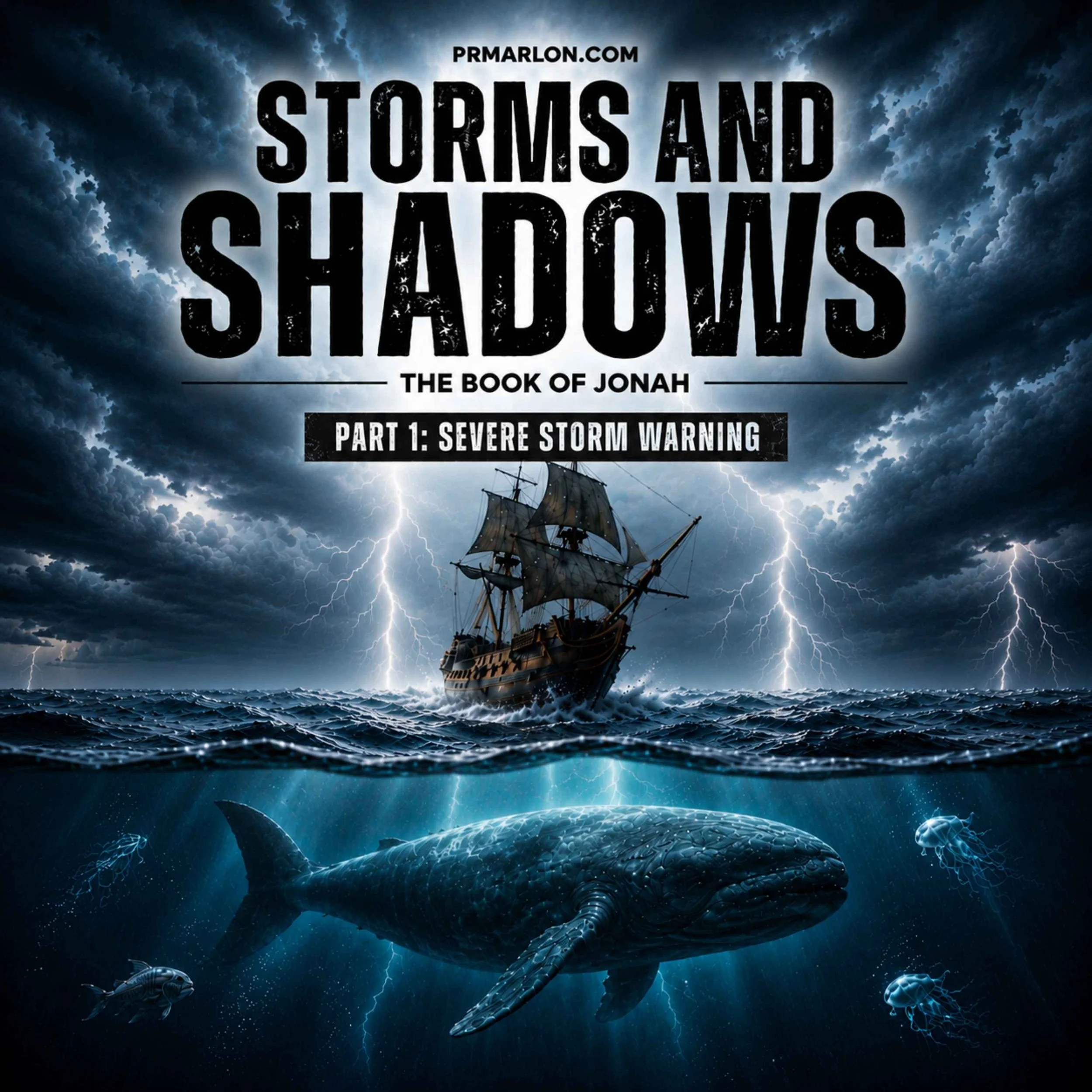
Except that now God sends a wind, and it causes a mighty tempest to break out on the sea, and the ship is barely staying in one piece. Interestingly, the Hebrew word used here for “send” (טוּל ṭûl) is often translated as “hurl” or “cast”. For example, when Saul cast the javelin trying to kill David (1 Samuel 18:11). So, in my mind’s eye, I imagine God hurling the wind like you would hurl a spear.
Fear
Then the mariners were afraid; and every man cried out to his god, and threw the cargo that was in the ship into the sea, to lighten the load. But Jonah had gone down into the lowest parts of the ship, had lain down, and was fast asleep.
—Jonah 1:5NKJV
Sailors tend to be rough and tough men. They’re not easily scared. But they noticed that this storm was no ordinary storm. They realized the ship could not last long under these conditions. The sailors began to cry out to their gods. A ship sailing to Tarshish likely has an international crew, each with their own religion and gods.
The ancient Near East’s religious environment included devotion to a multitude of “protecting spirits, patron deities, lower echelon gods and goddesses and senior members of the Pantheon,” which gave rise to an extremely confusing situation.
—Billy K. Smith and Franklin S. Page, Amos, Obadiah, Jonah, vol. 19B, The New American Commentary (Nashville: Broadman & Holman Publishers, 1995), 230.
These experienced sailors noticed something unusual about this storm and perceived it to have supernatural origins. When their prayers go unanswered, they begin to throw the cargo overboard in a desperate attempt to lighten the load and save the ship and, most importantly, their lives.
Let’s think through this together. What do you imagine the cargo of the ship is made up of? It is probably made up of all kinds of valuable things. I doubt they would fill the ship with worthless things. The cargo is likely filled with goods they hope to trade for a profit and food they would definitely need to survive. The sailors are desperately doing all that they can.
Once again, we have a significant contrast with Jonah. As everyone runs around doing their best to save themselves, Jonah is at the bottom of the ship, sleeping.
Call on your God
So the captain came to him, and said to him, “What do you mean, sleeper? Arise, call on your God; perhaps your God will consider us, so that we may not perish.”
—Jonah 1:6 NKJV
Jonah is awakened by a shocked captain. How can you be asleep at a time like this? Arise, call on your God! Interestingly, the Hebrew words used for “arise” (קוּם) and “call” (קָרָא) are the same words we read in verse 2 when God calls on Jonah to “arise” and to “cry out” against Nineveh. Ironically, we now have the captain calling on Jonah in a way that is reminiscent of what Jonah is trying to escape and what got them in this mess in the first place. Imagine deciding to run away from God just to be told by the captain to call upon God.
There is a supernatural storm raging, and nothing is working; the captain and the sailors are desperate, and none of the gods have been able or willing to help. The captain hopes that perhaps Jonah’s God might consider them and spare their lives.
There is extreme irony here: a “heathen sea captain” pleaded with a Hebrew prophet to pray to his God. It is sobering to see one who might be termed an “unbeliever” pleading for spiritual action on the part of a “believer.” The “unbeliever” saw the gravity of the situation while the prophet slept. It is a sad commentary when those who are committed to the truth of God’s word have to be prodded by a lost world into spiritual activity.
—Billy K. Smith and Franklin S. Page, Amos, Obadiah, Jonah, vol. 19B, The New American Commentary (Nashville: Broadman & Holman Publishers, 1995), 231.
Please tell us!
7 And they said to one another, “Come, let us cast lots, that we may know for whose cause this trouble has come upon us.” So they cast lots, and the lot fell on Jonah. 8 Then they said to him, “Please tell us! For whose cause is this trouble upon us? What is your occupation? And where do you come from? What is your country? And of what people are you?”
—Jonah 1:7-8NKJV
The sailors are convinced of the storm’s supernatural cause. Perhaps it was the unusual fury of the storm, or maybe it was its appearance in the wrong season. We are not told how they know this, but it is clear to the sailors that something beyond the physical realm is at work in this situation. Someone had angered the gods, and the sailors decided to cast lots to find out who was responsible.
The casting of lots was a widely used method in the ancient Near East. The most common word used for “lot” indicates that they were either stones or pebbles that were painted or colored. When the stones were thrown, if two dark sides landed up the usual interpretation was no. If two light sides landed up, that meant yes. A light and a dark side meant throw again. Using this system, the sailors dealt with each individual until the color revealed the guilty person. This specific means of discerning the Lord’s will is found many times in Scripture. For example, the casting of lots was the means for determining the guilt of Achan (Josh 7:14–18), for distributing the land to the tribes of Israel (Josh 18:10), and for selecting Saul as king (1 Sam 10:20–22). As Prov 16:33 says, “The lot is cast into the lap, but its every decision is from the Lord.”
—Billy K. Smith and Franklin S. Page, Amos, Obadiah, Jonah, vol. 19B, The New American Commentary (Nashville: Broadman & Holman Publishers, 1995), 232.
The lot fell on Jonah, and everyone turned to him for answers. The sailors know nothing about him, and they begin to inquire about his occupation, where he is from, his home country, and his people. I understand this line of questioning as an attempt to determine the cause of the storm, what could have angered the gods, and which gods Jonah serves or which gods he might have angered.
I worship the creator God
So he said to them, “I am a Hebrew; and I fear the LORD, the God of heaven, who made the sea and the dry land.”
—Jonah 1:9 NKJV
Jonah identifies himself as a Hebrew. The name by which the Israelites were frequently designated by those not of their race (Gen. 39:14; 40:15; 41:12; Ex. 1:16; 2:7; 3:18; 1 Sam. 4:6). We first see this name used in Gen. 14:13, referring to Abram and designating him a descendant of Eber. (Francis D. Nichol, ed., The Seventh-Day Adventist Bible Commentary, vol. 4 (Review and Herald Publishing Association, 1977), 999.) Depending on how you look at it, it can be ironic that Jonah identifies himself as a Hebrew, like Abraham, except Abraham obeyed God’s call and set out for the promised land. In contrast, Jonah runs away from God, perhaps looking for his version of the promised land.
Jonah adds that he fears YHWH, the covenantal name for God, revealed by God to Moses in Exodus 3:13-15, often written in English Bibles as LORD (all caps). The Hebrew word for God (Elohim) is a generic name for deity, and Lord (Adonai) is a title. Elohim is also used for false gods (Exodus 18:11, for example). So the use of YHWH identifies Jonah’s specific God, and he adds that He is the God of heaven who made the sea and the dry land, as opposed to a God that is limited to a geographical location or domain. I find it interesting that Jonah says that he fears YHWH, but if he really feared YHWH, he would not have disobeyed. And speaking of fear…
Exceedingly afraid
10 Then the men were exceedingly afraid, and said to him, “Why have you done this?” For the men knew that he fled from the presence of the Lord, because he had told them. 11 Then they said to him, “What shall we do to you that the sea may be calm for us?”—for the sea was growing more tempestuous.
—Jonah 1:10-11 NKJV
The sailors’ fear was confirmed: a god was causing this storm, except it wasn’t just a god; this was the creator God, the God of heaven who made the sea and the land. The men are terrified. “What have you done?!” is not a question about the nature of Jonah’s sin but rather an exclamation of horror. It is possible that these men had heard of the God of the Hebrews (see Exodus 15:13-16; Joshua 5:1; 1 Samuel 4:5-9). Their great fear could also be caused by the roar of the storm that was threatening to break their ship apart. Those sailors probably wondered what kind of suicidal fool runs away from the creator God?
The men turn to Jonah and ask what they should do to him. Jonah just wanted ot run away from God, to sleep in the belly of the ship and be forgotten, but now he is the leader of the men. They know only Jonah would know what needs to be done for the sea to be calm. The sea was becoming more and more tempestuous.
Throw me
And he said to them, “Pick me up and throw me into the sea; then the sea will become calm for you. For I know that this great tempest is because of me.”
—Jonah 1:12 NKJV
The supernatural ferocity of the storm and the casting of lots confirmed what Jonah already knew deep down inside: the great tempest was his fault. But Jonah shows no signs of repentance, nor does he confess his sins to God. Jonah seems simply resigned to his “fate.” He had rebelled against God, and now he deserved to die. He did not even try to ask for forgiveness. It could also be that Jonah would rather die than obey God and go preach in Nineveh.
It is worth noting that the captain asked Jonah to pray to his God in verse 6, but apparently Jonah was unwilling to do so. Then the men asked him what they should do to him, and now he tells them to throw him overboard. I don’t know why Jonah didn’t just jump overboard. Maybe that storm was a truly terrifying sight, and he could not bring himself ot do it. Maybe he did not want to commit suicide and preferred to be sacrificed for the storm to be calm for the sailors.
Plan B
13 Nevertheless the men rowed hard to return to land, but they could not, for the sea continued to grow more tempestuous against them. 14 Therefore they cried out to the LORD and said, “We pray, O LORD, please do not let us perish for this man’s life, and do not charge us with innocent blood; for You, O LORD, have done as it pleased You.”
—Jonah 1:13-14 NKJV
The behavior of the pagan sailors continues to amaze me. I expected Jonah to barely finish his sentence before they grabbed him and threw him overboard. He had already cost them their precious cargo, and their ship was likely damaged. These men are about to die, and instead of throwing Jonah overboard right away, they try to row to land. These exhausted and terrified men try absolutely everything to save themselves and Jonah. When they discover that it is absolutely impossible, they do something else that Jonah had refused to do: they cry out to the Lord.
The pagan sailors pray to God when Jonah is unwilling to. These men are more interested in Jonah’s salvation than he is. These men care more about God’s will than Jonah does. I find it fascinating that they are concerned that God would charge them with innocent blood. I would not consider Jonah innocent when his open and foolish rebellion against God has placed all their lives at risk. Yet these men pray to God, recognizing Him as the true God and a righteous judge. They recognize God’s sovereignty and that He has done as it pleases Him. The pagan sailors seek to honor and obey God, while Jonah refuses to talk to God.
Notice that Jonah’s wilful disobedience imperiled the lives of those men. Jonah’s rebellion not only affected him, but it also affected those around him. Sin never affects only the sinner.
By avoiding his responsibility Jonah forced responsibility on others. In avoiding his vocation he burdened others.
—Rosemary A. Nixon, The Message of Jonah: Presence in the Storm, ed. Alec Motyer, Derek Tidball, The Bible Speaks Today (England: Inter-Varsity Press, 2003), 110.
Yeeted
15 So they picked up Jonah and threw him into the sea, and the sea ceased from its raging. 16 Then the men feared the Lord exceedingly, and offered a sacrifice to the Lord and took vows.
—Jonah
When all else failed, the men finally picked up Jonah and threw him into the sea. And just like that, the sea became calm.
I see a theme here: God called Jonah to “arise and go,” but Jonah arises and goes in the opposite direction. Jonah goes down to Joppa, then down to the ship going to Tarshish, then down into the lowest parts of the ship and lies down.
God then throws (sends) a great wind on the sea, and a mighty tempest ensues. The sailors begin throwing the cargo from the ship into the sea to lighten the load. Looking for more cargo, they find Jonah in the lowest part of the ship, asleep. The captain of the ship calls Jonah to arise and call on his God. Jonah refuses. Finally, Jonah realizes the storm is his fault and tells the sailors to pick him up and throw him into the sea. Finally, Jonha is picked up and thrown, because he had refused to get up and go.
The sailors witnessed all of this and apparently were converted. (For a deeper dive see Isaiah 59:19; Micah 7:17; Zephaniah 2:11; Malachi 1:14; 3:5)
The verb for “fear” occurs first in v. 5 of the sailors’ fear of the storm, then in v. 9 of Jonah’s claim to reverence the Lord, then in v. 10 of the sailors’ terror of the Lord, and finally here of their profound awe before the Lord (cf. Luke 8:22–25). The expression (literally) “feared the Lord with a great fear” is the same as in v. 10 with the addition of “the Lord.” The obvious difference is that fear for their lives had turned to submissive awe, which apparently manifested itself in some degree of repentance.
—Billy K. Smith and Franklin S. Page, Amos, Obadiah, Jonah, vol. 19B, The New American Commentary (Nashville: Broadman & Holman Publishers, 1995), 237.
Usually, people make vows to God before they are saved, not after the fact. The sacrifices were likely offered once they reached land, which means they were not just a hasty vow made out of fear of destruction, but rather a desire to honor and serve the creator God. They had already been spared; they had made it safely to land; the sea had become calm; there was no present threat to motivate them to offer God sacrifices. So I believe they were converted, despite Jonah’s terrible witness.
I find it so ironic that Jonah is disobedient, does not even try to witness, refuses to pray, and yet everyone is converted. Those sailors had witnessed the awesome power of God; they had witnessed divine judgment, and they became convinced that the God of the Hebrews, the God of heaven, who made the sea and the dry land, was the true God and worthy of worship.
So Jonah’s sacrifice was not in vain; at least the men who were in the ship with him came to know the true God.
But wait, the story is not over.
The great fish
Now the Lord had prepared a great fish to swallow Jonah. And Jonah was in the belly of the fish three days and three nights.
—Jonah 1:17 NKJV
Jonah disobeyed God. Rejected God. Refused to pray to God. Would rather die than do God’s will. But God was not done with Jonah. We will continue with this story in my next post.
Reflections
The Gentile sailors are more awake than Jonah. They are doing naturally what he has been called to do; they seek deliverance while he seeks oblivion. In this event we see a foreshadowing of what is yet to come. The people of Nineveh, whose wickedness had come up before God, turn out to be more responsive to God’s word than Jonah, the prophet of the Lord. These tensions were the very stuff of the storm.
The actions of the sailors may have been driven by fear and panic. They were also practical expressions of their faith. Their gods may have been false, their beliefs may have been misguided, but their actions were thoroughly correct. They knew they were dependent on something greater than themselves; they knew how to express that dependence. Jonah’s God was the true God, his belief was well founded, but his actions were wrong. His beliefs and his actions were uncoordinated. He was ‘all at sea’. Right belief is no better than wrong belief if it is not corroborated by right actions.
—Rosemary A. Nixon, The Message of Jonah: Presence in the Storm, ed. Alec Motyer, Derek Tidball, The Bible Speaks Today (England: Inter-Varsity Press, 2003), 90.
This series is entitled Storms and Shadows because the story of Jonah is about so much more than a man being swallowed by a great fish. It is about our relationship with God and our responsibility to others, and the storms that are caused by the shadows in our lives, the portions of ourselves that we refuse to surrender to God.
Here’s what stood out to me:
God called Jonah because He was concerned with the wickedness of Nineveh. God sends Jonah, but Jonah does not want to go. God never cancels Jonah’s personality or freedom to choose. But that does not mean that there are no consequences to Jonah’s actions. Jonah’s rebellion endangers the lives of all on the ship. Although no one dies in the end, all witnessed the power of God and the foolishness of trying to run away from God. The experience not only teaches the sailors about the God of heaven who made the sea and the dry land, but also teaches Jonah what God is like. Instead of killing Jonah for disobeying Him, God uses this opportunity to reveal His power and character to the sailors who decide to worship him by the end of the trip.
Though the storm is a terrible and fearful judgment from God, no one dies. Everyone learns more about God and has the opportunity to make a decision. Jonah would rather die than obey God, but God is not done with him. God prepares a great fish and spares Jonah’s life. Jonah knows God, he hears God’s voice, and he chooses to disobey, yet God, in His mercy, spares Jonah and touches the lives of the sailors.
Jonah is unlike the wind and the great fish in that he says “no” to God, while everything else God sends obeys Him. We, like Jonah, can also say “no” to God’s calling in our lives.
Take away
So many sho seek God link obedience and performance to salvation. I won’t say they’re completely unrelated, but people often get the order mixed up, thinking they must be good to be saved, instead of understanding that good behavior follows salvation.
Neither Jonah nor the sailors offer the right sacrifices for their sins or the right prayers for salvation. They do not claim the name of Jesus Christ nor His blood shed on the cross for their sins. Yet God works with them based on what they know and where they are in their spiritual journey. Jonah’s disobedience did not doom him and everyone in the ship to destruction, but it made the whole experience much rougher than necessary.
In other words, when we obey God, we get the best possible outcomes in life. Not to be confused with “easiest” or “most comfortable.” Remember that Jonah chose death (being thrown into the sea) rather than repent and go preach in Nineveh. Sometimes what God calls us to do seems like a terrible idea, but this story reveals that to disobey God only makes things worse, not only for us but especially for those around us.
Think of all the pain and suffering that exist in the world today because people freely choose to disregard God’s calling for their lives. Think of all the positive experiences you have had in your life when you chose to follow God. I am not talking about easy experiences, but experiences that were overall positive.
My key takeaway is to shift my thinking regarding obedience. To think less about how obedience impacts me and whether or not it is a salvation issue, and think more about the mission. How my obedience to God’s calling impacts those around me.
God is merciful, and He is in the business of saving people, and He wants to use you in this process. Do you want to partner with God in blessing others?
(The story is not over, we will dive deep into chapter 2 in my next post)
Pst. In case you’re not yet subscribed to my newsletter, here’s one that has some bonus historical information on the story of Jonah.