The Hellenization of Christianity: What Every Christian Should Know
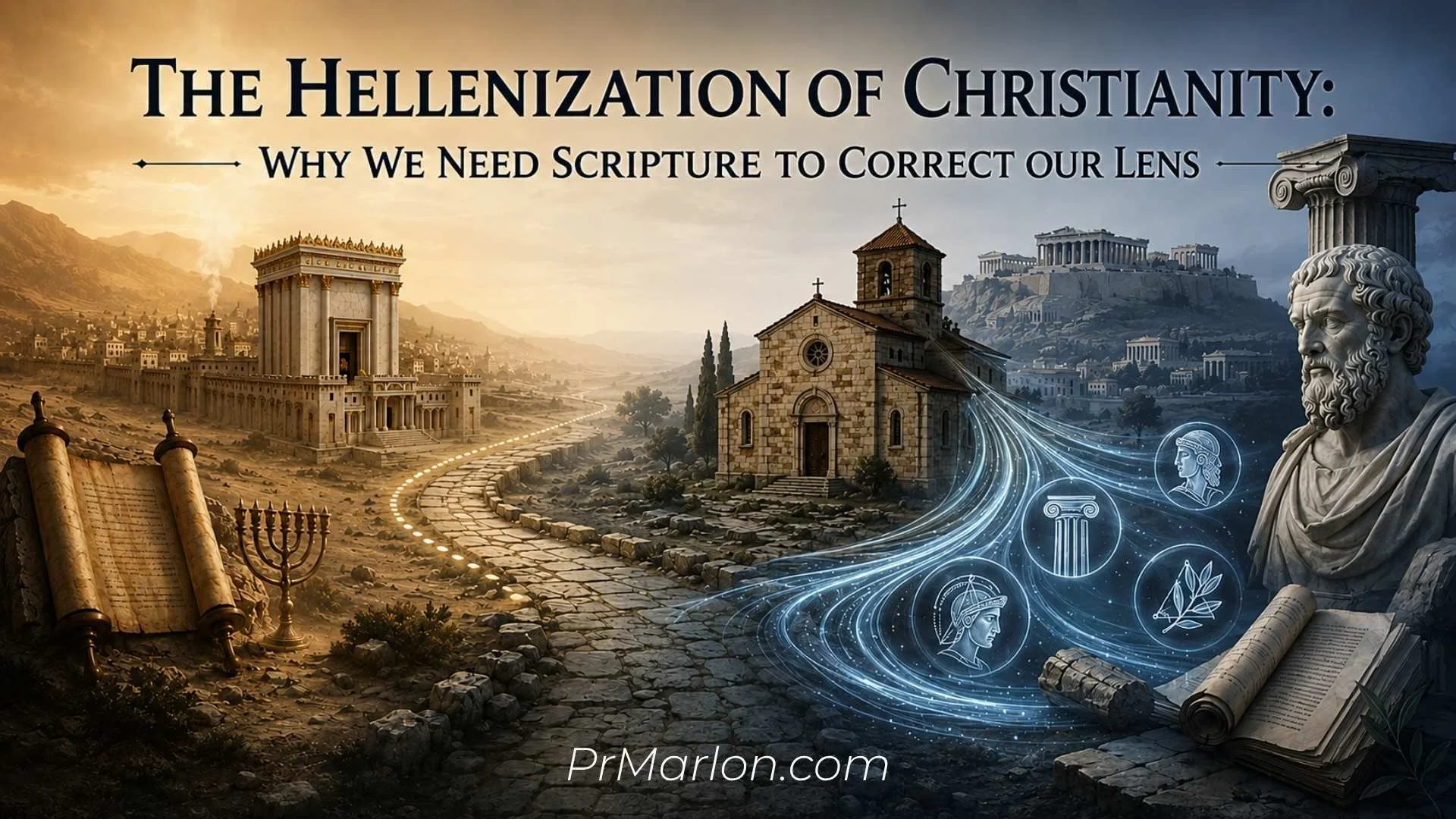
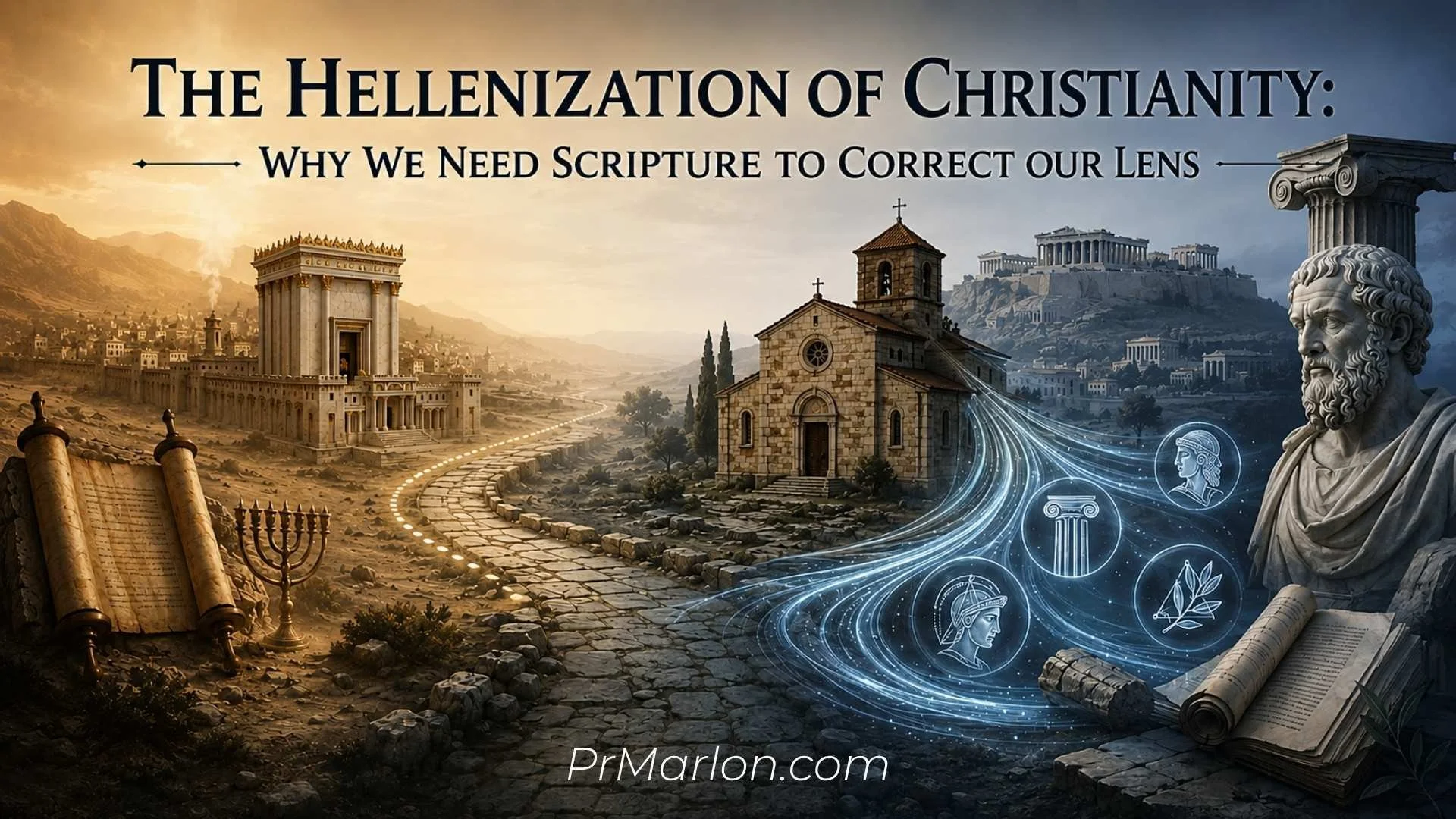
The Hellenization of Christianity: Why We Need Scripture to Correct Our Lens
(This post is a continuation of my post on the remnant. The gist of that post was that God’s remnant is not a denomination that suddenly appeared in 1863. God’s remnant consists of His faithful people throughout the entire history of salvation—from Adam and Eve to the Second Coming of Christ.)
Every generation reads Scripture through some interpretive lens. The question is not whether we have one, but whether Scripture itself continually corrects our lens.
Storytime
While I attended the Adventist Theological Seminary at Andrews University in Michigan, I visited a couple of churches that were not my faith as part of a class assignment. This time, I’ll focus on my visit to Mars Hill Bible Church in Grandville, Michigan. This church was founded by Rob Bell. I had read at least one of his books and had enjoyed his NOOMA videos. Rob Bell was among the most influential pastors at the time, and Mars Hill Bible Church was one of the fastest-growing churches in America. Needless to say, I was excited for the opportunity to visit his church and hear him preach. So I joined two of my classmates, and we carpooled for the hour-and-a-half drive from Berrien Springs to Grandville.
I remember being surprised that the church didn’t look like a church; it met in what used to be a shopping mall. I walked in, found a seat, and to my surprise and joy, the sermon was on the Parable of the Ten Virgins found in Matthew 25. I am familiar with this parable about the second coming of Jesus. The music was top-notch, and the sermon was delivered with great skill. But one thing bothered me as I left. On the drive back, I asked my classmates what they thought about the experience. We talked about the chairs, the music, the building, the order of service, and Rob Bell’s undeniable skill. But one thing bothered me, and I asked my friends whether they had noticed that Bell had not once mentioned the second coming of Jesus. He talked about Jewish weddings and went into depth regarding the cultural aspects, the meaning and beauty of Jewish weddings, the great celebration, and why you would not want to miss out. My friends didn’t seem bothered by it. They argued that the sermon was well delivered and that the message was clear: we did not want to miss out on the great celebration Jesus had prepared for us.
But I was bothered. How could someone preach on Matthew 25 and never mention the literal and historical Second Coming of Jesus? Maybe it’s because I am a Seventh-day Adventist, and the second coming of Jesus is always on my mind. Maybe other pastors just don’t give much thought to the literal and historical second coming of Jesus. Maybe it was nothing; maybe it was just a personal bias or preference; or maybe it was evidence of a different worldview.
Oversimplified History (my personal take)
Israel had repeatedly disobeyed God and gone into exile (2 Kings 17:7–23). The Old Testament is full of these stories. Israel disobeyed God, suffered consequences, and turned back to God. You see this happen again and again. By the time Jesus shows up, Israel had a new temple, often called the Herodian Second Temple. It was massive! And the Jews were very proud of it. To make sure Israel would never again be dispersed, the Jewish leaders made sure to follow the laws very carefully. They even added more laws on top of the ones given in the Bible.
They really wanted to make sure everyone obeyed God. Sadly, in this process, the focus shifted from God and His great love for the world to how special Israel was because they were so obedient, and the more obedient they were, the more blessings they would receive. Worship and religiosity slowly became more and more about power and control, and less about God. God became a tool for earthly power and influence.
Jesus is born into this context. The Jews are God’s people; they have the law and the prophets; they worship the true God, but their religious leaders were losing sight of the character of God and God’s plan of salvation. They made their religion about them and not about God. This is what Jesus reacts to in His ministry (see Matthew 23). The problem is not the Old Testament, the laws, or the prophets, but what the religious leaders had done with it.
Who Is the Sheepfold Today?
And other sheep I have which are not of this fold; them also I must bring, and they will hear My voice; and there will be one flock and one shepherd.
—John 10:16 NKJV
When Jesus spoke the words recorded in John 10:16, what was or who made up the fold? Israel was the fold; Jesus was talking about Gentiles (non-Jews) who would hear His voice and follow Him. Is Israel still the fold today? No, we now consider “the church” to be the fold. Israel stopped being the fold when they rejected Jesus and the gospel. (See Acts 7 and the stoning of Stephen, Romans 11:17-24 branches broken off)
I mention this to highlight that it is possible to be God’s special people and then no longer be it. Whenever we abandon God’s word in favor of our own ideas, we create an idol, a version of God created in our own image.
A Gradual Shift
As fallen humans, left to our own thoughts and reason, even with the best of intentions, we drift away from God ( Romans 3:23; Ephesians 2:3; Jeremiah 17:9; Romans 7:18; Genesis 6:5). Unless we are anchored in the Bible, our best decisions over time will cause us to drift from God’s will. I am not saying this happens on purpose or that there is a great conspiracy; maybe at times this was the case, but even in the best scenarios, with the best of intentions, we will drift from God if not connected to His word. There is a fascinating book series by Adolf Harnack on the History of Dogma; it is 7 volumes long and very heavy reading, but here is a great question he poses in volume 1, page 47.
How and by what influence was the living faith transformed into the creed to be believed, the surrender to Christ into a philosophic Christology, the Holy Church into the corpus permixtum, the glowing hope of the Kingdom of heaven into a doctrine of immortality and deification, prophecy into a learned exegesis and theological science, the bearers of the spirit into clerics, the brethren into laity held in tutelage, miracles and healings into nothing or into priestcraft, the fervent prayers into a solemn ritual, renunciation of the world into a jealous dominion over the world, the “spirit” into constraint and law?
—Harnack, Adolf von. History of Dogma. Translated by Neil Buchanan. Vol. 1. 7 vols. New York: Dover Publications, 1961. p47
I share this quote not because I agree with everything Harnack wrote but because I believe his question is worth asking. When we look at Christianity in our time, can we trace our religious practice and beliefs to the Bible? I do not mean that everything without a clear biblical precedent is bad, but that we should be aware of what is biblical and what is cultural. We should understand that cultural aspects of our religious experience are subject to change, but the biblical principles are not.
When we look at the history of the Christian faith, we see that struggle. The early Christians sought to reach non-believers while remaining faithful to the gospel as revealed by God in the Bible.
Nevertheless, it is true that in its language and sometimes in its ideas orthodox Christian doctrine still bears the marks of its struggle to understand and overcome pagan thought, so that what later generations of the church (including those generations that were themselves ignorant of antiquity) inherited in the dogma of the church included more than a little of Greek philosophy as well.
— Jaroslav Pelikan, The Christian Tradition: A History of the Development of Doctrine, 5 vols. (Chicago, IL: Chicago University Press, 1971-1989), 1: 45.
I am not arguing that there was a conspiracy to mix Christianity and Greek philosophy, but rather that, in attempting to explain the gospel, Christians used the language and arguments of Greek philosophy to present Christ and make Him known to their neighbors in their Hellenistic context. This is not bad, but that language became an increasingly important part of Christian theology and culture.
Jaroslav Pelikan points out how Clement of Alexandria, in Stromateis (Miscellanies), Book 4, Chapter 3, pictures man as “a dual being like the centaur of classical myth, made up of body and soul;” He uses this to illustrate how “it was the lifelong task of the Christian “philosopher gnostic” to cultivate the liberation of the soul from the chains of the body, in preparation for the ultimate liberation, which was death.” (Pelikan, 1: 47.) This is only a small sample of Clement’s extensive integration of Hellenistic philosophy (particularly Platonism and Stoicism) with Christian theology, where he argues that Greek philosophy served as a preparatory tool for the pagan mind, similar to how the Mosaic Law prepared the Jews to lead them to faith in Christ.
Clement of Alexandria was arguing with unbelievers and trying to present the gospel in a way that would be appealing and would make sense to them. It should not surprise anyone that Christianity overlaps with and completes the best philosophy the world has ever seen. Clement of Alexandria portrays “the intellectual and moral superiority of the Christian way to anything that even the noblest paganism had been able to discover.” (Pelikan, 1: 46.) In the Exhortation to the Greeks (Protrepticus), Clement appealed to his philosophical colleagues to complete their worldview by accepting Christ. Clement presented Jesus as the missing piece of their comprehensive conception of the universe and of their relation to it.
Whenever people point out similarities between Christianity and Stoicism, Buddhism, or other philosophies, I am not surprised. Every serious search for truth uncovers glimpses of God’s reality. The danger arises when philosophy begins to shape Scripture rather than Scripture evaluating philosophy. This is a constant and present danger in the development of our theology. We look for parallels and ways to understand God, using our language, logic, and lived reality. This is not bad, but we must continue to compare our theology and beliefs to the law and the testimony. If our insights are not in harmony with the Bible in its entirety, we still have work to do. This reminds me of the words of Isaiah:
To the law and to the testimony! If they do not speak according to this word, it is because there is no light in them.
—Isaiah 8:20 NKJV
As we go through life, we are constantly developing our theology, and it can seem consistent and beautiful, and we can be proud of it. Still, we must resist the temptation to develop it apart from and in contradiction to what the Bible has to say.
Distancing from Judaism
Christians can’t remain unaffected by their environment. Culture impacts all of us. Over time, Christianity distanced itself more and more from Judaism. I do not fault them. It was the Jewish leaders who had Jesus crucified. However, in rejecting the flawed system that Jesus also opposed, many ended up rejecting the Old Testament, which Jesus, Paul, and the New Testament quote and stand on.
Adolf Harnack points out how, as a consequence of the complete break with the Jewish Church, there followed a strict necessity of quarrying the stones for the building of the Church from the Græco-Roman world. As a result, Christianity has a more positive relationship with that world than with the synagogue. (Harnack, p.47)
The Old Testament provides the foundation for the New Testament, and when it ceased functioning as Christianity’s primary interpretive framework, you needed a new foundation. This happened slowly over time, over a series of well-intentioned and logical decisions. Canale sees it this way:
Christian leaders facing the world of culture, science, and reason, decided, for various reasons, not to reject the leading scientific culture of their days: Greek philosophy in its Neoplatonic format. Historians of Christian theology label this process the “hellenization” or alternatively the “de-Judaization” of Christianity.
—Fernando Canale, “On Being the Remnant,” Journal of the Adventist Theological Society 24, no. 1 (2013): 133.
Over time, the Christian Church and its doctrine were developed within the Roman world and Greek culture; after all, this was the culture they were living in. The major problem is that this was done in opposition to the Jewish Church and, as a result, the importance of the Old Testament was slowly downplayed. Slowly, over time, anything that seemed Jewish was removed from Christian theology, worship, and culture.
There is no doubt that Israel had a sacred treasure that was of far greater value than all the treasures of the Greeks, in essence, the living God! The main problem was in what “miserable vessels was this treasure preserved,” and how much inferior the Jewish people were in comparison with the riches, the power, and freedom of the Greek spirit and its intellectual possessions. (Harnack, p.48)
I am not very familiar with Greek philosophy; I have a beginner-level understanding of it, but men who have studied it more thoroughly than I notice this. And this is not from Adventist theologians. Adolf von Harnack, for example, is a German Lutheran theologian and historian, and this is what he has to say regarding this shift in Christian doctrine.
On this foundation we meet with a religious mode of thought in the Gospel and the early Christian writings, which so far as it is at all dependent on an earlier mode of thought, is determined by the spirit of the Old Testament (Psalms and Prophets) and of Judaism. But it is already otherwise with the earliest Gentile Christian writings. The mode of thought here is so thoroughly determined by the Hellenic spirit that we seem to have entered a new world when we pass from the synoptists, Paul and John, to Clement, Barnabas, Justin or Valentinus.
—Harnack, p.49
I am not advocating that you study Greek philosophy to spot its influence in Christian theology. Rather, I encourage you to read the Bible to the best of your ability, to understand it, and to allow it to interpret itself. I am not promoting Judaism; I am arguing for a holistic interpretation of the Bible. When you see the whole as one picture, you will notice the discrepancies when they arise. You don’t need to study Greek philosophy to spot the issues; the more you familiarize yourself with the Bible, the easier it becomes to spot the inconsistencies between Christian culture and Biblical teachings.
What is God like? (case study)
But what are the practical implications of the Hellenization of Christianity? One example that comes to mind is our concept of God.
From the Old Testament, we get a clear picture of God interacting within history (Exodus 3), answering prayers (2 Kings 20:1-11), working wonders (1 Kings 18:38), and experiencing emotions (Jeremiah 31:3; Deuteronomy 1:37; Judges 2:18; Genesis 6:6). The Old Testament is clear that God does not change (Malachi 3:6; Numbers 23:19; Psalm 102:27) but the Old Testament understanding of this is that God’s character remains the same. The Old Testament is not concerned with the substance of God but rather with His character. Yet, over time, God has come to be seen as existing outside of time.
The Platonic idea of divine immutability had a significant impact on the development of theological reflection on God and time. Divine immutability, namely the idea that God cannot change, combines elements of Plato’s ontology of the Forms – which are perfect, immaterial, and unchanging – with perfect being theology. Plato argued in Republic (Republic 381b–c) that a perfect being cannot change because they are unable to improve, being already perfect, and they cannot deteriorate as this would mean they cease to be perfect. Following the Aristotelian commitment to unity of time and change, a being who cannot change was believed to be outside of time by necessity. Divine immutability reverberated throughout Christian tradition, its legacy lasting for centuries. It is arguably a leading reason why divine atemporality played such a significant role in Christianity’s intellectual history.
—St. Andrews Encyclopedia of Theology
(University of St. Andrews in Scotland, a Catholic University, not to be confused with Andrews University, which is a Seventh-day Adventist University in the US)
A brief overview of the implications of God’s timelessness (there is vigorous ongoing debate over this) is that if God is timeless and so are our souls, these doctrines tend to shift the emphasis away from the Second Coming, since our souls go to heaven the moment they are freed from the temporal world by death. This also means that the physical world is bad and physical pleasure is probably sinful. The Old Testament says that the physical world is very good and meant to be enjoyed (Genesis 1-2). Can you begin to see the challenges?
Whether or not this explains Rob Bell’s sermon, it illustrates how one’s doctrine of God influences which biblical themes receive emphasis. The second coming of Jesus is not the main focus. I am not saying this is the reason for his approach to the parable of the 10 virgins. Still, I would not be surprised if the importance of the second coming of Jesus is not central in many Christian circles because of their view of God and the immortal human soul. Also, where in the Bible does it say that humans have an immortal soul? The second coming of Jesus fades into the background as not particularly necessary, mysterious, and perhaps symbolic. One of those things we don’t fully understand, so we just avoid it. Ask someone to explain the second coming and the physical resurrection to you, and see how much of it makes sense. Yet many hold on to the immortality of the soul and the timelessness of God (philosophical concepts) because letting go of those views would mean giving up the very foundation of their worldview.
Culturally, have you ever seen the devil depicted as the god of the underworld, the ruler of hell? Where is that in the Bible?
These are simple, perhaps simplistic, examples. The differences are subtle, never necessarily said out loud, but they quietly shape the culture from behind the scenes. Greek philosophy guides and shapes much of Christian theology and culture, as if by an invisible hand. Many Christians ignore or downplay the importance of the Old Testament, not because they were told to, but because it feels like a different God, a different culture, a different religion. It is often not seen as an integral part of Christianity, maybe as a weird cousin that you put up with.
Faithful to Scriptures
Israel was the sheepfold when Jesus was on earth. But they placed their man-made religious rituals and rules above the word of God. Many Jews saw how Jesus fulfilled prophecies and what their temple services pointed forward to. They accepted and continued to grow in their personal relationship with God. Others rejected Jesus and clung to their religious and cultural customs.
All of Christianity is in danger of doing the same, mixing religion and politics and philosophy, and making God in our image as opposed to coming to the Bible and allowing it to challenge our views of God. Like the religious leaders of Jesus’ time, we are in danger of drifting away from what the Bible teaches. It happens gradually, slowly, over time.
Just like Judaism became something so different that they rejected Jesus as the Messiah. The Christian church got to a point where people did not have access to the Bible. It was for their own good, so that they would not become confused and pervert the pure gospel. It was safer to leave it to the professionals. Eventually, the church service was also done in a language that most common people did not speak, but that was not on purpose; it was to keep the message faithful and united. It protected the purity of the church and its teachings. After all, the people were illiterate and ignorant. Why burden them with trying to figure out theology?
When Martin Luther read the Bible and realized discrepancies between what it taught and what the church taught, he was persecuted. I get the mistrust of religious institutions. But the lack of organization seriously hinders the church’s mission. Over the next three centuries, the Protestant principle of returning to Scripture continued producing new movements and fresh study of the Bible.
Millerite Movement
Let’s skip forward in history again until we arrive in the US in the 19th century. We meet William Miller, a farmer and student of the Bible. Because he is an American, he believes he can do this himself. He begins to study the Bible and focuses especially on prophecy. To understand prophecy, he has to study the Bible in its entirety, the Old and New Testaments. He becomes convinced that Jesus is coming again in a literal, physical event.
But Miller is only a farmer; he is not a theologian, and he is just studying the Bible and expecting to understand it. He does not have the rich theological heritage of those who came before him. As he studies, he becomes convinced that he has figured out the date for the second coming of Jesus. Silly William Miller, no one told him it couldn’t be done. The movement grows, and, once again, I am oversimplifying it; the date was wrong, and Jesus did not return. There was a great disappointment. Many were convinced that this is why you don’t let just a bunch of laypeople try to read the Bible for themselves. This is better left to the professionals, and definitely don’t even try to understand biblical prophecy; no one can understand that.
One group of former Millerites refused to give up. They continued to study, and as they did, they began to discover more and more things besides just prophecy. These silly Americans from different denominations thought they could understand the Bible on their own, under the guidance of the Holy Spirit. Because they studied prophecy, they became accustomed to looking to both the Old and New Testaments and challenging their preconceived notions about the immortality of the soul, the nature of hell fire, a physical and historical second coming of Jesus, the importance of the Sabbath rest as a gift from God to all of creation and not just a Jewish institution.
As their theology developed and they shared it, others joined the movement. They resisted organizing for years. They, like many today, did not trust organized religion. They were aware that organizations can resist change and prioritize self-preservation over their mission and adherence to the Bible. But eventually they had to organize for the sake of the mission, to reach the entire world with the gospel and an emphasis on the soon return of Jesus.
Perhaps it was because none of them had formal theological training that they felt more comfortable abandoning the traditional approach to biblical interpretation. Also, they were small enough to take risks to believe and follow what they were discovering from the Bible itself. They were reading the Bible with fresh eyes, coming together from different denominations to find out what it had to say. They found themselves appreciating and embracing the 10 commandments, not only 9, not as a means of salvation but as a revelation of God’s plan for His people, not only the Jews in the Old Testament but for everyone throughout earth’s history. On that note, I recommend The Decalogue Before Mount Sinai (free PDF). The gist of it is that all the laws written in the Ten Commandments existed long before God wrote them with His finger on tablets of stone, and they were not meant just for Israel but for everyone.
Suddenly, when they read Revelation 12:17, they saw themselves—a group of Christ followers who embraced both the commandments of God and the testimony of Jesus Christ.
And the dragon was enraged with the woman, and he went to make war with the rest of her offspring, who keep the commandments of God and have the testimony of Jesus Christ.
—Revelation 12:17 NKJV
They arrived at this point by studying the Bible and allowing the biblical text to challenge their preconceived notions, gradually replacing their interpretive framework from a Hellenistic worldview to a biblical one. Their work is not finished; it continues with us. This work will not advance among Christians who sit back and expect to be entertained on weekends. This work moves forward with those who are willing to wrestle with the biblical text and allow it to challenge their preconceived notions.
But isn’t it dangerous? Absolutely. We cannot do this carelessly, but we also cannot afford not to. We move forward prayerfully. Meeting together, sharing our insights, pushing back respectfully, and digging deep into the word of God. Not trying to save ourselves, but seeking a better understanding of Jesus as revealed in the Bible.
Takeaway
I want to encourage you to:
Pray for the guidance of the Holy Spirit.
Prayerfully read your Bible and allow it to challenge you.
Join a group that is studying the Bible.
Be extra sensitive to how things are being interpreted and whether the interpretation is internally consistent with the rest of the biblical text.
Keep Learning — Be open to correction and growth.
It is okay not to have all the answers. It is fine to ask questions and even make some mistakes. How else will you learn? Just don’t neglect the practice, the habit, of spending time in prayer and Bible study. Not that these behaviors save you, but they help strengthen your personal relationship with your God.
Once again, this is meant to be a conversation starter, not the final word. What are your thoughts? Let me know in the comments section.
Epilogue: Emerging Remnant
And other sheep I have which are not of this fold; them also I must bring, and they will hear My voice; and there will be one flock and one shepherd.
—John 10:16 NKJV
I believe that we are part of the current sheepfold, and that Jesus is also calling others. They join because Jesus is calling them. Rob Bell is no longer the pastor of the Mars Hill Bible Church. He wrote a controversial book questioning the doctrine of an eternally burning hellfire and what that says about the character of God. More recently, Kirk Cameron hosted a conversation about hellfire titled Hellgate: The Christian Debate We’re Afraid to Have. He was heavily criticized, but I admire him for speaking out and being willing to have difficult conversations. Rob Bell was also heavily criticized for questioning the traditional stance on eternally burning hellfire. I am not saying I agree with these men, but I am excited to see these topics discussed because I see them as opportunities for God’s Remnant to come together, following Jesus and the Bible—questioning and rejecting aspects of our faith that did not come from the Bible but from a Hellenistic worldview.
Along the same lines, many Christians were discussing the Sabbath when Charlie Kirk’s book Stop, in the Name of God: Why Honoring the Sabbath Will Transform Your Life came out. I am not saying I agree with everything he says, but if it gets people asking questions and turning to the Bible for answers, I am happy for it. The more people we have asking questions and turning to the Bible for answers, the better. I am not here to push “Adventist theology.” I am here for biblical theology, and I am open to learning. Flawed as the Seventh-day Adventist Church is, I remain convinced that it seeks to follow the biblical text more consistently than any other Christian tradition I have personally studied. I am open to studying and being proven wrong, but only if it comes from the Bible.