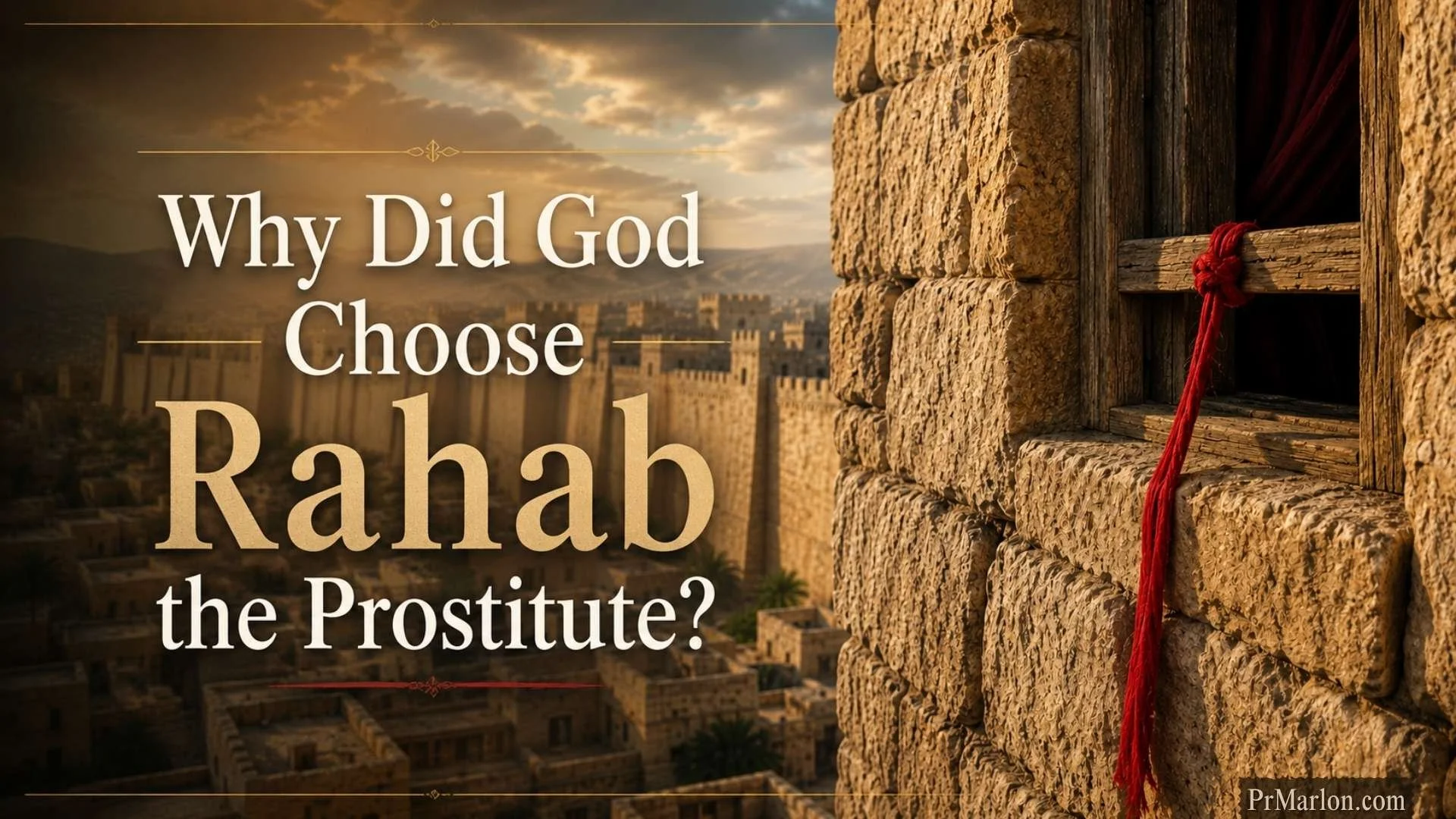
Why Did God Choose Rahab the Prostitute?
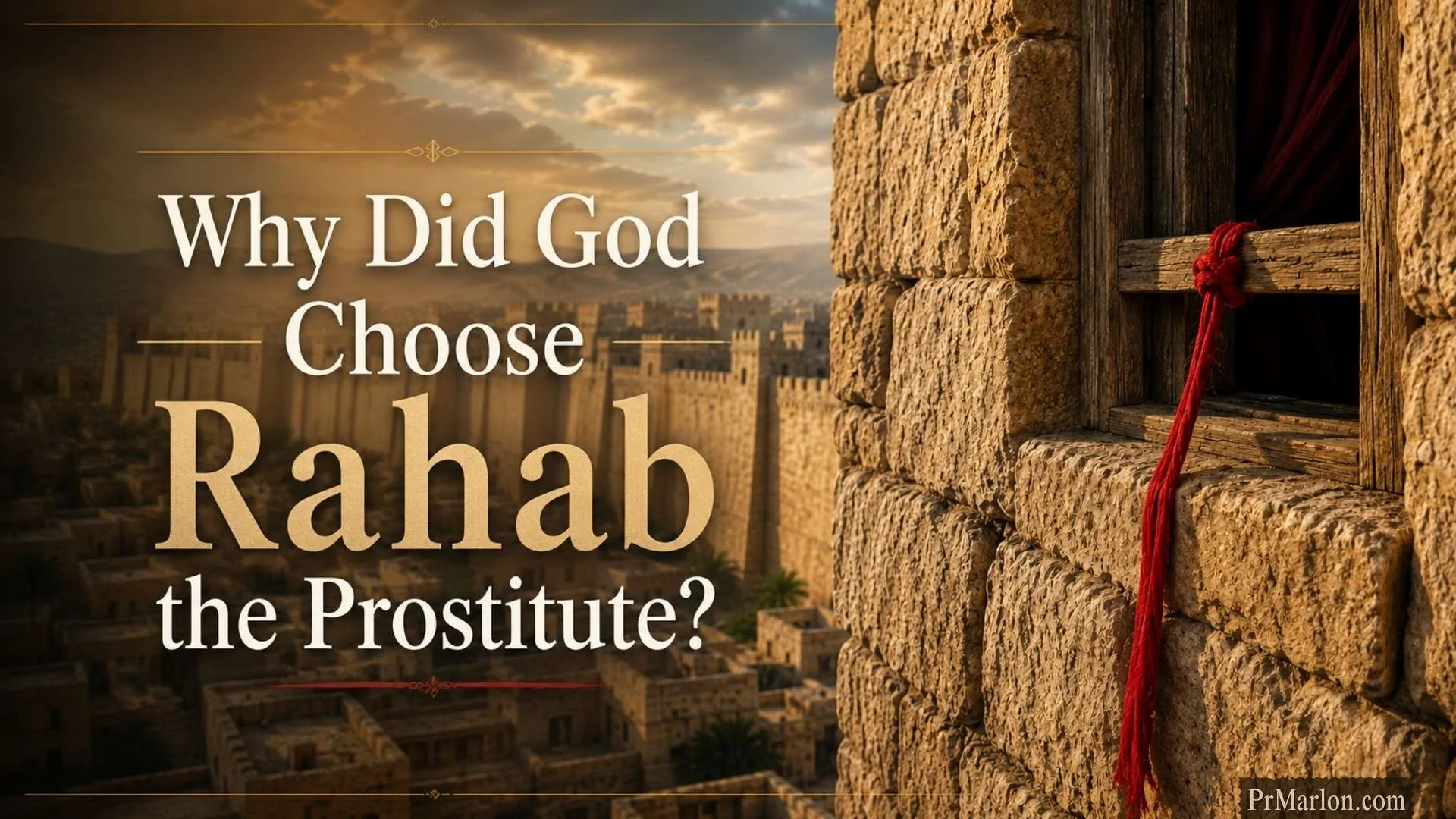
God Is Not Afraid of Messy People: The Story of Rahab
If you were choosing the first Canaanite convert to become part of God's people, whom would you choose?
A king?
A respected priest?
A military commander?
God chose a prostitute.
Everyone knew Rahab the prostitute.
God knew her as His daughter.
In this post, we will explore how God is not afraid of messy people and that your past does not disqualify you from God’s future.
Spies!
Now Joshua the son of Nun sent out two men from Acacia Grove to spy secretly, saying, “Go, view the land, especially Jericho.”
So they went, and came to the house of a harlot named Rahab, and lodged there.
—Joshua 2:1 NKJV
Joshua’s dispatch of spies reminds us of Moses’ sending out of the 12 spies into Canaan from the wilderness (Numbers 13-14). That ended up being a negative experience because 10 of the spies brought a negative report, and the people rebelled, resulting in them wandering in the wilderness for 40 years until the entire rebellious generation died off, except for Joshua and Caleb, who believed that God could give them victory in battle. (Numbers 14:26-35)
Danger?
Joshua sent the spies from Acacia Grove or Shittim (Hebrew name) (Joshua 2:1), and that is where the Israelites had rejected their God and prostituted themselves with the Moabite women and gods at Balaam’s instigation. (Numbers 25:1-3; 31:16) This consideration paints Rahab as a potential danger. She is a harlot, and the spies should be nowhere near her.
The narrative does not suggest that the spies and Rahab had any sexual relations, and there is sufficient historical evidence, dating back to the writings of Josephus (100 AD), suggesting that Rahab ran an inn rather than a brothel. (see footnotes for a deeper dive)
A less explicit but valid point is that the soldiers would likely have maintained ritual purity, because if the spies had acted inappropriately, we should expect consequences similar to those seen in Joshua 7 regarding Achan’s sin.
Despite all this evidence, Rahab is still mentioned as a harlot in the biblical text.
Please, just Rahab is fine…
Even though there is strong historical, grammatical, and contextual support for Rahab and the Israelite spies not engaging in any type of sexual behavior, Rahab is often referred to as a harlot.
I did a simple word search, and the English word Rahab came up 12 times in the Bible. Of the twelve occurrences, 4 were not references to her (slightly different Hebrew spellings but the same in English), so, out of the 8 biblical references to Rahab (the woman who helped the spies), only 3 don’t include the word “harlot.” I imagine Rahab telling people, you can just call me Rahab, no need to include the harlot part. The repeated reference to Rahab as a harlot bothers me. Why attach that title to her? If the intention is to identify her as opposed to other Rahabs, why not Rahab from Jericho or some other identifier? Reflecting on this, I wonder if the biblical references to her as a harlot are intentional, not to shame her but to highlight God’s willingness to not only save but fully embrace her as His daughter and a part of His special people despite her sordid past.
I wonder if the efforts of others to portray Rahab as an innkeeper are out of a sincere desire to be historically accurate, or if they are embarrassed that a harlot/prostitute plays such a significant role in the biblical narrative. Rahab’s title in Hebrew זָנָה (zānâ) and in Greek πόρνη (pornē) are clear; there is no debate about the meaning and usage of these terms. So when historians, theologians, and preachers refer to Rahab as an innkeeper, are they being kind to her, or are they trying to sanitize the Bible in an attempt to make it more palatable to modern audiences, and perhaps with the best of intentions, missing a key point the biblical text is making?
I am reminded of Jesus’ words recorded in Matthew 21;
Jesus said to them, “Assuredly, I say to you that tax collectors and harlots enter the kingdom of God before you. 32 For John came to you in the way of righteousness, and you did not believe him; but tax collectors and harlots believed him; and when you saw it, you did not afterward relent and believe him.
—Matthew 21:31b-32 NKJV
Maybe we wish that the Bible as a whole and even Jesus made fewer mentions of sinners and harlots. We can wish the Bible were different all day, or we can take the biblical text for what it says. It is worth noting that for a woman who perhaps ran an inn in a pagan city, Rahab is mentioned often in the Bible, including both Old and New Testament References (Joshua 2:1, 3; 6:17, 23, 25; Matthew 1:5; Hebrews 11:31; James 2:25).
Worst Spies Ever?
And it was told the king of Jericho, saying, “Behold, men have come here tonight from the children of Israel to search out the country.”
—Joshua 2:2 NKJV
I imagine the spies being told to blend in; they ask how, and are told to act normal; they promptly proceed to fail at it. The text does not tell us how long the spies were in Jericho, but from the narrative's flow, it seems they were spotted right away. Especially the mention of “tonight.” At this point in the story, it feels like the mission is a complete failure.
What will Rahab do?
So the king of Jericho sent to Rahab, saying, “Bring out the men who have come to you, who have entered your house, for they have come to search out all the country.”
—Joshua 2:3 NKJV
The spies were immediately recognized and reported to the king. Now the king was asking Rahab to bring out the men who had entered her house. How do you expect a Canaanite harlot to respond? I expected her to hand over the spies immediately; it would be the best way to maintain the status quo and maybe even get on the king’s good side. At first glance, Rahab has nothing to lose and everything to gain by handing over the Israelite spies to the king. If Rahab was content with her life and the way things were going, why would she risk the king’s anger by doing anything other than what she was instructed to do?
After all, as a harlot living in Jericho, I imagine she does not have a lot of power. She’s a woman without a husband. Who would defend her? Who would fight for her? Given her line of work, I imagine most people would rather deny knowing her. Would her father even show up in court to defend her? Life as a prostitute in ancient Canaan would almost certainly have been dangerous, unstable, and marked by vulnerability.
Faith in action
4 Then the woman took the two men and hid them. So she said, “Yes, the men came to me, but I did not know where they were from. 5 And it happened as the gate was being shut, when it was dark, that the men went out. Where the men went I do not know; pursue them quickly, for you may overtake them.” 6 (But she had brought them up to the roof and hidden them with the stalks of flax, which she had laid in order on the roof.) 7 Then the men pursued them by the road to the Jordan, to the fords. And as soon as those who pursued them had gone out, they shut the gate.
—Joshua 2:4-7 NKJV
In an unexpected turn of events, Rahab hides the spies and lies to the king’s emissaries. Why would Rahab do something so risky? Why turn her back on her king for foreigners she barely met? Rahab’s courage and boldness show that she is strong, independent, and willing to take risks.
But she lied though…
So, should we talk about the fact that Rahab just told a big lie?
Rahab's lie raises one of the most difficult ethical questions in Scripture. Christians have answered it in several ways. One main issue I take with this debate is how many discuss this event as if Rahab were a great biblical moral example to be emulated. The biblical narrative presents her as a Canaanite prostitute who is seeking God. She does the best she can with what she knows. It is important for us to differentiate between a biblical description telling you what happened (Rahab lied) and a biblical prescription telling you what you should do (Let your ‘Yes’ be ‘Yes,’ and your ‘No,’ ‘No’ [Matthew 5:36]).
(see footnotes for a deeper dive)
Rahab’s faith
8 Now before they lay down, she came up to them on the roof, 9 and said to the men: “I know that the LORD has given you the land, that the terror of you has fallen on us, and that all the inhabitants of the land are fainthearted because of you. 10 For we have heard how the LORD dried up the water of the Red Sea for you when you came out of Egypt, and what you did to the two kings of the Amorites who were on the other side of the Jordan, Sihon and Og, whom you utterly destroyed. 11 And as soon as we heard these things, our hearts melted; neither did there remain any more courage in anyone because of you, for the LORD your God, He is God in heaven above and on earth beneath. 12 Now therefore, I beg you, swear to me by the LORD, since I have shown you kindness, that you also will show kindness to my father’s house, and give me a true token, 13 and spare my father, my mother, my brothers, my sisters, and all that they have, and deliver our lives from death.”
—Joshua 2:8-13 NKJV
Rahab knew that God had given the Israelites the land because her people, the inhabitants of the land, were terrified of Israel. They had heard of God’s mighty works: the crossing of the Red Sea (Exodus 14) and their victories over the two kings of the Amorites (Numbers 21:21-35). Rahab knew that the God of the Israelites was God over everything. Rahab was converted before the spies ever spoke to her. She heard what God had done and was deeply convicted by the truth.
Rahab did not find the God of Israel to be an interesting theory, or the God of just the Jews. Clearly, the LORD (YHWH) was more powerful than all the other gods, and His jurisdiction was not limited by geographical location. What does Rahab’s speech teach us?
From Rahab’s speech, we learn that God revealed Himself to the people of Canaan. Before the physical conflict began, the people of the land were convinced of God’s power. There was enough evidence to convince Rahab beyond a shadow of a doubt. This is made clear by her disobedience to her king in favor of helping possibly history’s worst spies. Rahab could have interpreted the spies' incompetence as a red flag, but instead she likely saw it as an answer to prayer, an opportunity for salvation.
Out of all the places in the city of Jericho, what are the odds that the spies happen to come to the house of a woman who believes in their God? Could it be that God knows her heart, loves her, and desires to save her? Could the God of Israel, the creator and sustainer of the universe, have heard and answered the prayer of a Canaanite prostitute?
Later, we find out that God’s strategy for conquering Jericho will involve marching around the city (Joshua 6:3-5), so it’s not like they needed or used any strategic information gathered by the spies. Though Joshua did not yet know it, he would not need the spies' intelligence to plan his attack. The way I see it, the main reason for the spies going to Jericho was God’s desire to save Rahab and her family. Interestingly, God used Rahab to save both the spies and her family.
Rahab would have been someone most people pitied. A prostitute living in a pagan city. We are not told what her family thought of her line of work, but given what we know about the culture, it is reasonable to imagine they were not proud of her or her work. I wonder if the spies chose her house because she seemed like an easy target, or because it was a place where people were used to being discreet and looking the other way. A part of town no one paid much attention to, and a woman no one would believe, or at least a woman who would be less likely to speak up or want to call attention to herself. Instead, in an unforeseen reversal, Rahab saves the two spies.
If you were Joshua, whom would you send on such a dangerous mission? Presumably two of Israel's most capable men. Yet they fail almost immediately and are rescued by the very person most readers would expect to need rescuing—a prostitute. Rahab saves not only the two spies, but also her father, her mother, her brothers, her sisters, and all that they have. God delights in turning our expectations upside down.
Rahab was not a helpless damsel in distress living in the tower of a castle in need of being saved by a knight in shining armor. Her life was complicated, marked by painful choices and a broken world. She did the best she could with the opportunities available to her. She was a fighter, but despite her best efforts, she needed help. She wanted out. She did not want to continue to live that life. God saw her distress and witnessed her brokenness. His heart broke for her aching heart. (Psalm 34:18; 56:8; 147:3; 1 Peter 5:7) God revealed Himself to her. She accepted Him and embraced Him. Her faith was so strong that she knew that He was God in heaven above and on earth beneath. She was saved by grace through faith, and her faith was so strong that she defied the king of Jericho.
The king of Jericho had once been her king.
But Rahab now had a new King.
The King of Kings and Lord of Lords.
Rahab’s walk with God is not passive; she puts her faith into action, doing what she can. She recognizes her agency, and she seizes her opportunity. Rahab’s life is messy, she is accustomed to navigating a world of lies and deceit; these have been tools of her trade. Now she uses what she knows, but this time to save the lives of not only the Israelite spies but also her own and the lives of her parents and siblings. Rahab’s life is still complicated; she's bound to make mistakes, but her aim is towards God and salvation. God takes her as she is and uses her, flaws and all, to save those around her. (Acts 16:31)
Out of all the people of Jericho, God chose to save a harlot?
Why not members of the royal family? Why not key military leaders? Why not wealthy merchants or wise scholars? Why did God not persuade more people to accept Him and join His people? It is not about who God wants to save, but who wants to be saved. Rahab was not superior to anyone else. Perhaps what sets her apart from everyone else is her desire for salvation, her hunger for a new life, and her hunger for freedom. Perhaps those who lived more comfortable lives were more concerned with maintaining the status quo.
13 “Enter by the narrow gate; for wide is the gate and broad is the way that leads to destruction, and there are many who go in by it. 14 Because narrow is the gate and difficult is the way which leads to life, and there are few who find it.
—Matthew 7:13-14 NKJV
Based on the wider testimony of Scripture, I believe God gave the people of Canaan enough light to respond to Him. (John 3:16) But the good news only found fertile ground in Rahab’s heart. (Matthew 13:1-23) But maybe you wonder at my use of “good news.” Wouldn’t it be bad news that Israel is coming? If it is bad news, why does Rahab see it as good news? Jesus’ words recorded in Matthew 24 might help clarify this.
Then the sign of the Son of Man will appear in heaven, and then all the tribes of the earth will mourn, and they will see the Son of Man coming on the clouds of heaven with power and great glory.
—Matthew 24:30 NKJV
Whether the coming of Jesus is good news or bad news depends on you. For those who are tired of their current situation and long for a closer relationship with God, it is great news! For those who are comfortable and perhaps have no desire to surrender their lives to God, the coming of Jesus is terrible news. No one can serve two masters. (Matthew 6:24) When confronted with the reality of God, we can humble ourselves and experience salvation and a new life in Him, or we can harden our hearts and resist. (Exodus 8:15,32; 9:34)
The fact that Rahab believed and was saved demonstrates that all had the chance and anyone could be saved, even a harlot. Yet everyone else in Jericho responded differently. Rahab’s story shows that genuine faith was possible even among the inhabitants of Canaan. The majority, nevertheless, chose to fight, already knowing they would lose. God revealed Himself to them, and they were free to make their choices. (Deuteronomy 30:19; Ezekiel 18:32; John 15:22; Luke 12:47)
Rahab was the first Canaanite convert to the belief in the God of Israel recorded in the Bible. But she is not necessarily the only one. I believe her story is powerful and teaches us important truths about salvation, the character of God, and our agency in life.
Takeaway
God is willing to save us, regardless of the mess we currently find ourselves in. Our past mistakes, repeated poor choices, and shortcomings do not scare God or prevent us from being deeply loved by God. God wants to save us. We must believe in him, receive His salvation as a gift, and then live a new life in Jesus boldly. Rahab’s life did not become automatically easy. I cannot imagine the anxiety and fear she must have experienced along with all the inhabitants of Jericho as the Israelite army marched around the city day after day. But she was safe through it all, because God is faithful.
Maybe you have already given your heart to Jesus, have been baptized, and are concerned about your current situation and immediate future. There is nothing wrong with you; life is messy, and we don’t know the details of what will happen. But we remind ourselves that we serve a mighty God, and He will never leave or forsake us. (Deuteronomy 31:6,8; Hebrews 13:5-6; Joshua 1:9; 1 Peter 5:7;Romans 8:28)
Maybe you have not given your heart to God yet, and the idea of taking that step terrifies you. It is terrifying to abandon what you have known your whole life to follow a God you’re still getting to know. The good news is that though life still has its challenges when you’re following God, you can be assured of victory.
And we know that all things work together for good to those who love God, to those who are the called according to His purpose.
—Romans 8:28 NKJV
Oh, and one final note that is worth highlighting. Rahab was fully embraced by God and His people, and the clearest evidence of this appears in Matthew 1:5, where she is one of the four women mentioned in the genealogy of Jesus. God did not just save Rahab; Jesus was born from her lineage. God is not ashamed of Rahab the prostitute, and He is not ashamed of you.
God did not just forgive Rahab; He placed her in His family.
He wants to do the same for you.
Footnotes
David M. Howard Jr., Joshua, vol. 5, The New American Commentary (Nashville: Broadman & Holman Publishers, 1998)
Danger? - a deeper dive
The vocabulary of the end of Joshua 2:1 could connote sexual liaisons (the words “entered” and “stayed there” in v. 1—literally, “came” and “lay there”—are often used elsewhere of sexual intercourse; see, e.g., Gen 6:4; 16:2; 30:3; 34:7; 39:7, 10, 12). (Howard Jr., 98.) At this point, it might be worth noting that Joshua sent the spies from Acacia Grove or Shittim (Hebrew name) (Joshua 2:1), and that is where the Israelites had rejected their God and prostituted themselves with the Moabite women and gods at Balaam’s instigation. (Numbers 25:1-3; 31:16)
David Howard Jr. explains the original text in the following manner:
The verb bwʾ (“entered”) is used commonly for entering a building (e.g., Judg 9:5; 2 Sam 12:20; 2 Kgs 19:1), and when it is used to indicate a sexual liaison no direct object (such as “the house”) is used; the pattern is for a preposition to follow, e.g., “and Samson went in [entered] to her” (Judg 16:1; cf. Gen 6:4; 16:2; 30:3; etc.). Also, when the verb škb (“lay there”) is used to indicate a sexual liaison, it occurs with a following preposition such as ʾim or ʾet “with,” which is not the case here.
—David M. Howard Jr., Joshua, vol. 5, The New American Commentary (Nashville: Broadman & Holman Publishers, 1998), 98.
Though the words “entered” and “lay there” can be used as a reference to sexual intercourse, the grammatical structure of Joshua 2:1 does not suggest that the spies and Rahab had any sexual relations.
In addition to the sentence structure of the original text, there is also enough historical evidence suggesting that Rahab ran an inn and not a brothel (See Hess, Joshua, 83–84 and M. Weinfeld, The Promise of the Land: The Inheritance of the Land of Canaan by the Israelites (Berkeley: University of California Press, 1993), 142–44, on the existence and function of such inns in Canaan and the ANE. This evidence renders even more plausible the grammatical evidence just noted against a sexual encounter having taken place. The suggestion that this was an inn rather than a brothel is common and dates back to Josephus (Ant. 5.1.2).
Rahab’s Lie - a deeper dive
In Christian ethics, there are three main positions that most Christians fall into. I will lay them out as possibilities, along with the verses they usually cite in support of their views. The view I find most appealing is “non-conflicting absolutes.”
Conflicting Absolutes - (sometimes called “realism”) you must choose the lesser of two evils. In some situations in this sinful world, there is no option but to sin, so commit the lesser of the two sins and repent afterward. (1 John 1:9)
Graded absolutism - (sometimes called “hierarchalism”) there is an ordered hierarchy of absolutes, and some values have priority over others, so act according to the greater good.
Hebrew midwives lying to Pharaoh in order to save the Israelite boys. (Exodus 1:15-21)
Jesus saying people should hate fathers, mothers, etc., and follow Him instead. (Luke 14:26)
Jesus saying that some matters of the law, such as tithing certain spices, were less important than others, such as justice and mercy. (Matthew 23:23-24)
For a deeper study of the Graded Absolutism position see Geisler, Ethics, 114–36; id., Christian Ethics, 113–32; M. J. Erickson, Relativism in Contemporary Christian Ethics (Grand Rapids: Baker, 1974), 129–53; J. J. Davis, Evangelical Ethics: Issues Facing the Church Today (Phillipsburg, N.J.: Presbyterian & Reformed, 1985), 12–16; P. Barnes, “Was Rahab’s Lie a Sin?” RTR 54 (1995): 1–9.
Nonconflicting Absolutes - sin is never the only option; it only appears that way at first glance.
God is faithful and will not let you be tempted beyond what you can bear; God always provides a way of escape. (1 Corinthians 10:13)
Why not say, “Let us do evil that good may come? (Romans 3:7-8)
For a deeper dive into Nonconflicting Absolutes, see the representative treatments by J. Murray, Principles of Conduct: Aspects of Biblical Ethics (Grand Rapids: Eerdmans, 1957), esp. pp. 123–48; E. W. Lutzer, The Morality Gap: An Evangelical Response to Situation Ethics (Chicago: Moody, 1972), 75–113; W. C. Kaiser, Jr., Toward Old Testament Ethics (Grand Rapids: Zondervan, 1983), esp. pp. 222–34 and 271–74; id., Hard Sayings of the Old Testament (Downers Grove: InterVarsity, 1988), 95–97; R. V. Rakestraw, “Ethical Choices: A Case for Non-Conflicting Absolutism,” CTR 2 (1988): 239–67. Two early Church writers who took this position with respect to the issues of truth-telling and lying were Augustine and Thomas Aquinas; see Augustine, On Lying and To Consentius: Against Lying, in P. Schaff, ed., A Select Library of the Nicene and Post-Nicene Fathers of the Christian Church (Grand Rapids: Eerdmans, 1980 reprint), 3:455–500; Thomas Aquinas, The Summa Theologica (London: Burns Oates and Washbourne, 1922), 12:76–98.
Excursus
But did God not warn Israel against making alliances? (Exodus 23:32, Exodus 34:12-14, and Deuteronomy 7:1-2.) God’s prohibition against alliances was to prevent idolatry; this was not an issue of ethnicity. We have not only this clear example from Rahab but also the story of Ruth (for my series on Ruth, click here), where God accepts and embraces outsiders into His people. Remember Jesus’ words recorded in John 10.
And other sheep I have which are not of this fold; them also I must bring, and they will hear My voice; and there will be one flock and one shepherd.
—John 10:16 NKJV
Female Bible Characters
Perhaps you have noticed that kids’ Bibles and Bible cartoons often feature few stories with prominent, strong female characters. I do not think they intentionally avoid strong female characters, but I wonder if these stories are often messier and more complex and therefore tend to be avoided. In this post, I explored the story of Rahab.
For posts on other strong female characters, check out my posts on Tamar and Abigail.