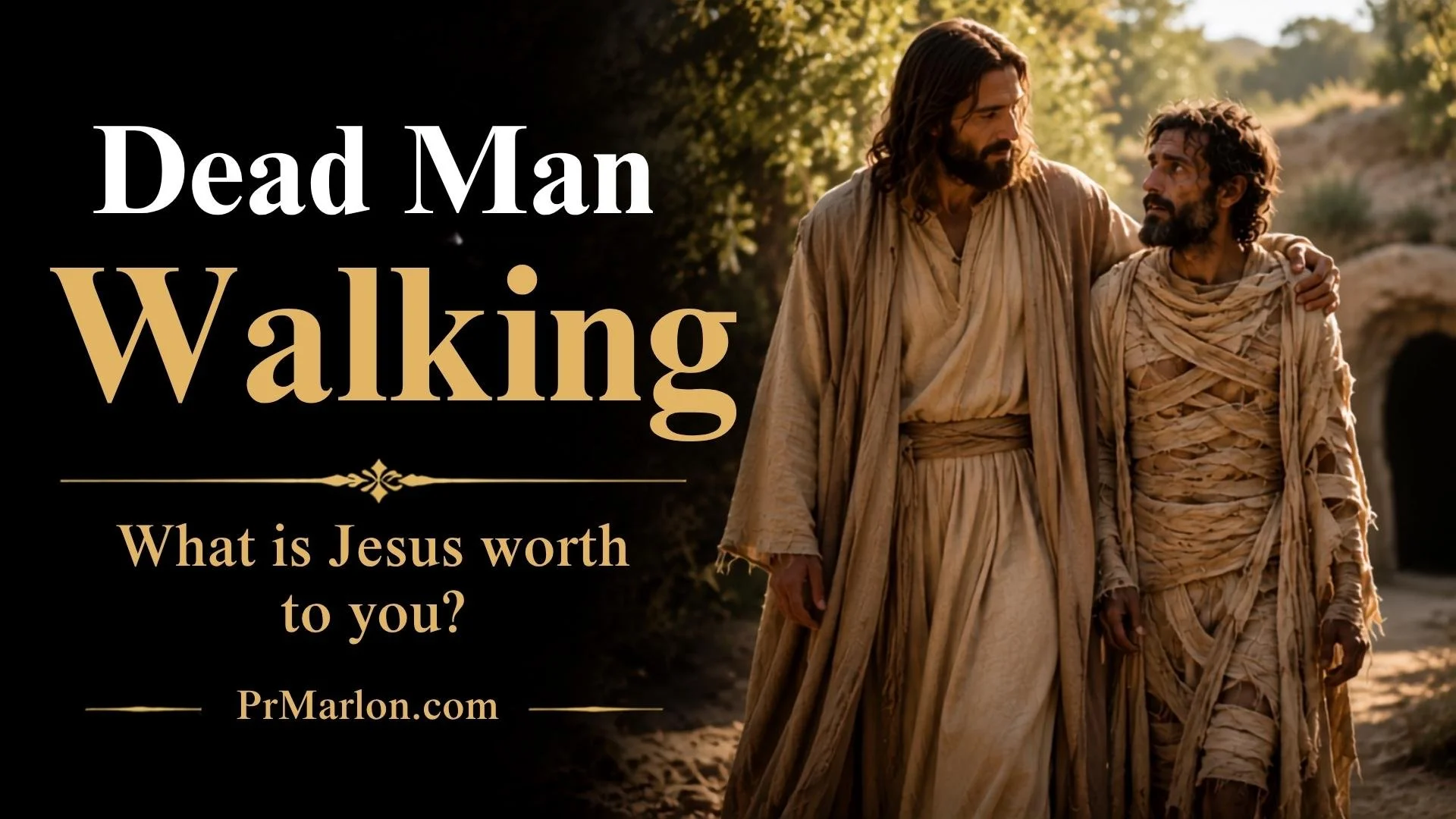
Dead Man Walking
What Are You Afraid to Lose for Jesus?
The greatest obstacle to surrendering to Jesus is not always a lack of evidence. Sometimes it is fear of what obedience will cost.
This is my third and final post on John 11 and the story of Lazarus. (You can read Part 1 - Why did Jesus Let Lazarus Die? and Part 2 - When God Asks You to Move the Stone)
In Luke 16:19-31, Jesus tells the parable of the rich man and Lazarus. In this parable, the rich man begs for someone to go to his brothers from the dead, hoping it would cause them to repent. The answer was, “If they do not hear Moses and the prophets, neither will they be persuaded though one rise from the dead.” (Luke 16:31 NKJV)
In this parable, Jesus teaches that a demand for additional miraculous evidence cannot transform a heart that refuses the witness already given through “Moses and the Prophets.” Interestingly, someone named Lazarus does come back from the dead, and not everyone believes.
What do you do when the evidence for Jesus becomes impossible to ignore—but following Jesus begins to threaten something you are afraid to lose?
Brief Recap
Previously in John 11
Lazarus died.
Jesus intentionally delayed.
Martha and Mary struggled with Jesus' absence.
Jesus arrives four days after Lazarus's death.
Jesus asks those present to remove the stone sealing the tomb.
Jesus calls Lazarus back to life.
When Jesus called Lazarus back to life in the presence of all who were there, and they witnessed the resurrection, the story should have ended with everyone praising God and recognizing Jesus to be who He claimed to be: the Son of God, the Messiah, their Savior.
Many Believed
Then many of the Jews who had come to Mary, and had seen the things Jesus did, believed in Him.
—John 11:45 NKJV
I am not surprised that many believed in Jesus; what surprises me is that not everyone did. Who could possibly deny who Jesus was in light of all He had done? They had noticed Jesus’ way of life, heard His teachings, and witnessed a great miracle! No wonder many believed, but many does not mean all.
But some…
But some of them went away to the Pharisees and told them the things Jesus did.
—John 11:46 NKJV
We are not told why some went away to the Pharisees and told them the things Jesus did. Maybe they were convinced and excited, and wanted the Pharisees to believe as well. Maybe they wanted everyone to be united in following Jesus and believing in Him. But the way the story flows, it seems like their intention was not to help.
The Council
47 Then the chief priests and the Pharisees gathered a council and said, “What shall we do? For this Man works many signs. 48 If we let Him alone like this, everyone will believe in Him, and the Romans will come and take away both our place and nation.”
—John 11:47-48 NKJV
Here we see the heart of the issue. It was not about compelling evidence regarding Jesus' identity. The council's concern was losing their place and their nation. Losing their power and influence.
The Great Sanhedrin in Jerusalem was generally composed of seventy of the leading priests (who were mostly Sadducees) and the revered rabbinic scribes (who were mostly Pharisees), with the ruling high priest serving as the seventy-first member who would vote to break ties in the court.
—Gerald L. Borchert, John 1–11, vol. 25A, The New American Commentary (Nashville: Broadman & Holman Publishers, 1996), 364.
The members of the council do not express doubt regarding Jesus’ many signs. Their concern is what will happen if everyone believes in Jesus. They saw Jesus as a threat to the place, nation, and security they were trying to preserve.
It is also worth noting that the Sadducees denied the possibility of the resurrection (Matt. 22:23; Acts 23:8). They must have been furious at having one of their principal theories so thoroughly disproved. It is no wonder they now joined the Pharisees in open hostility to Jesus. The Gospel of Matthew records how the chief priests played a leading role in the arrest, trial, and condemnation of Jesus (see Matt. 20:18; 21:15, 23, 45; 26:3; etc.). (Francis D. Nichol, ed., The Seventh-Day Adventist Bible Commentary, vol. 5 (Review and Herald Publishing Association, 1980), 1017.)
We may be tempted to look down on those religious leaders with contempt. After all, how could they reject Jesus after such an undeniable miracle? When you add to that Jesus’ character and teachings, and all the ways His life fulfilled the Old Testament prophecies concerning the Messiah, there was plenty of evidence for anyone to believe that Jesus was who He claimed He was. But what about us?
We have access to both the Old and New Testaments. We know that Jesus is God; we know He is our Savior. But how many of us are willing to have Him as Lord? If faithfulness to Jesus threatens to cost us our job, are we willing to be faithful to Jesus? What if following Jesus costs us our place and nation? I have heard many Christians say something along the lines of “God understands my situation.” I agree; God does. We are the ones who fail to understand our situation properly. We must be careful, lest we find ourselves living like the members of that council, the chief priests and Pharisees of Jesus’ day, deciding that believing in Jesus is too inconvenient.
A prophecy
49 And one of them, Caiaphas, being high priest that year, said to them, “You know nothing at all, 50 nor do you consider that it is expedient for us that one man should die for the people, and not that the whole nation should perish.” 51 Now this he did not say on his own authority; but being high priest that year he prophesied that Jesus would die for the nation, 52 and not for that nation only, but also that He would gather together in one the children of God who were scattered abroad.
—John 11:49-52 NKJV
Caiaphas was the high priest that year, and even though he rejected the Messiah and ultimately rejected God, God still spoke through him. How ironic that the high priest did not realize the vast significance of his own words. Perhaps this was due to the office or, more likely, due to God’s faithfulness to His people, but John tells us that the high priest’s words carried a prophetic meaning beyond his awareness. Caiaphas was talking of killing Jesus in order to maintain his position, power, and influence. He did not realize how true his words were, and that Jesus would die not only for the nation of Israel, not only for the members of that council, but for all the children of God who were scattered all over the world. Jesus would unite the entire world and bring salvation to everyone who believed in Him (John 3:16).
Plotting to kill the Messiah
53 Then, from that day on, they plotted to put Him to death. 54 Therefore Jesus no longer walked openly among the Jews, but went from there into the country near the wilderness, to a city called Ephraim, and there remained with His disciples.
55 And the Passover of the Jews was near, and many went from the country up to Jerusalem before the Passover, to purify themselves. 56 Then they sought Jesus, and spoke among themselves as they stood in the temple, “What do you think—that He will not come to the feast?” 57 Now both the chief priests and the Pharisees had given a command, that if anyone knew where He was, he should report it, that they might seize Him.
—John 11:53-57 NKJV
The members of the council do not express doubt that Jesus raised Lazarus from the dead. Yet they made up their minds that Jesus needed to die before more people believed in Him and the Romans came and took away their place and their nation. This highlights that the evidence was not the problem, but rather the fear of what would happen if more people believed. What a tragedy—to plot to kill the Son of God to preserve their current comforts instead of receiving the One who came to save them.
The plan to kill Jesus was in place; Jesus was a dead man walking.
No position, comfort, relationship, reputation, or sense of security is worth losing eternal life.
Verse 55 caught my eye. Many are coming to Jerusalem to purify themselves for the Passover feast. Nevertheless, their religious leaders were inexpungibly stained by sin as they ruthlessly plotted the death of the innocent Son of God.
What the council feared
What are we willing to lose rather than lose Jesus? The religious leaders were afraid of losing their place, their nation, their power, their influence, and their comfortable arrangement with Rome. In trying to preserve those things, they were willing to reject—and ultimately kill—the Messiah.
We have a powerful example of a Pharisee who did choose to follow Jesus later. Here is what he wrote about his experience.
7 But what things were gain to me, these I have counted loss for Christ. 8 Yet indeed I also count all things loss for the excellence of the knowledge of Christ Jesus my Lord, for whom I have suffered the loss of all things, and count them as rubbish, that I may gain Christ 9 and be found in Him, not having my own righteousness, which is from the law, but that which is through faith in Christ, the righteousness which is from God by faith; 10 that I may know Him and the power of His resurrection, and the fellowship of His sufferings, being conformed to His death, 11 if, by any means, I may attain to the resurrection from the dead.
—Philippians 3:7-11 NKJV
Paul was willing to count all that he had: his achievements, his education, his careful obedience to the laws and customs. He gave up his position, his identity, his community; he counted it all as loss for Jesus. Paul understood the cost and was willing to pay. Paul understood that if Jesus is who He says He is, it changes everything.
The members of the council were unwilling to give up what they had to receive Jesus. Paul was willing to lose everything because he had found something infinitely more valuable.
Conclusion
The council's problem was not a lack of evidence; it was cost. Receiving Jesus threatened what they valued most.
What are you afraid to lose?
Is there a job you would not risk for Jesus?
A relationship you would not surrender?
A lifestyle you do not want Him to disrupt?
A reputation you cannot bear to lose?
A sense of security you are holding so tightly that there is no room left to follow Jesus?
The religious leaders tried to save their place and their nation by rejecting Jesus.
In the end, they lost both.
Following Jesus may cost us much, but He is not a threat to our security. He is our Savior. We gain everything when we surrender to Jesus; He is the resurrection and the life!
So what are we afraid to lose?
Sometimes the greatest obstacle to following Jesus is not a lack of evidence. Sometimes the problem is that we already know enough and must decide what Jesus is worth. Paul understood that nothing he could lose compared to what he gained in Christ.
What is Jesus worth to you?
Footnotes:
Sanhedrin historical context
Regarding the historical context, I discovered that although the expression “chief priests” in John 11:47 may be a general reference to leading priests, it is probably best understood as referring to the family members of the Annas clan, who held the office for years. Both the Romans and the general public were suspicious of this clan because of its self-serving practices. Indeed, the Romans removed several high priests, including Annas, because they came into conflict with the Roman procurators/prefects. So, although the high priests normally held tenure for life, at times in the first century their tenure was not long. (Gerald L. Borchert, John 1–11, vol. 25A, The New American Commentary (Nashville: Broadman & Holman Publishers, 1996), 364.)
What if…
It is true that Jesus had to die, but everyone who betrayed Him did so freely. Though Caiaphas prophesied, it does not mean that he had no other options. The high priest and religious leaders could have chosen to follow Jesus. It is very likely that the Romans would still have killed Him, and the members of the council would have been innocent. The Romans could have believed in Jesus and become followers of God. Jesus could have been killed as a sacrifice. But now we have wandered into speculation land. My main point is that though God used the high priest to prophesy, it does not mean that the high priest was predestined to be actively involved in the plot to kill Jesus. It was his own ambition that led him to seek Jesus’ life.