When God Asks You to Move the Stone: Lessons from Lazarus
Trusting Jesus When You Don’t Know How Things Will Turn Out
Last Sunday I woke up at 3 AM. I had gone to bed around 11 PM on Saturday. We got up early to get ready and make sure we didn’t forget anything. We got dressed, gathered our kids, made sure we had packed everything, and got into our rental car. I followed the GPS to the Boston Logan International Airport. Our flight was scheduled to depart at 8:15 that morning. Everything was going according to plan. This time, I did not miss any turns or get lost. We made it to the rental car return with no issues, took the shuttle, cleared security, and made it to the gate just in time to learn our flight had been delayed due to mechanical issues. This delay meant we would lose our connecting flight in Chicago and miss our flight to Boise. We went to the American Airlines special services desk, but no one was there. As the stress and frustration mounted, we went from gate to gate trying to find someone to help us. After lunch, we finally found someone who helped us book a United flight out of Chicago on Monday morning.
There were many more frustrations, but I think I shared enough to give you an idea of how challenging it was to get home from Boston. I had been praying for safe travels and for God’s will to be done, as I often do, and most of the time everything goes well. This time everything seemed to be going wrong. As my wife, my two children, and I tried to remain calm and kind despite our frustration, sleep deprivation, and at times anger, I began to reflect on the sermon I had preached about Lazarus. Being stuck for about 15 hours in the Boston airport and having to spend a night in Chicago was not great, but it was a fairly small inconvenience in the grand scheme of things. I wondered how Martha and Mary felt as their brother was dying and Jesus delayed and appeared not to care. I thought of times I had cried out to God regarding the health of my wife or one of my kids. By comparison, this was an inconvenience, but no lives were at stake. Also, how privileged are we to be frustrated that it would take two days to travel from Boston to Boise?
I decided to practice what I preached and rest in the assurance that God was in control, that everything would work out, and that we had done all that we could. Being angry at each other or at American Airlines would not solve our problem, though we agreed to do all we could to avoid ever flying on American Airlines again. So I chose to smile, be kind to my wife and kids, and pray and thank God that, by faith, everything would work out. This was not easy, and my problems were not miraculously solved. By the time we made it to our hotel, it was midnight Chicago time, and we had to wake up at 5 AM to make our flight to Boise, but we did, and it all worked out.
This experience reminded me that working as a pastor and dedicating my life to ministry and preaching the gospel does not guarantee everything will go well. Sometimes I am tempted to complain about that, but I remember I do not deserve the blessings I receive and that I am blessed beyond measure.
Faith is not just trusting in Jesus when you know the outcome; it is resting in Him when you don’t know how things will turn out. I couldn’t make more seats appear on the flight; I couldn’t fix the plane faster, but I could trust in God and remain calm and loving through the process. My faith didn’t make the problem go away, but it helped me deal with my frustrations in a less destructive way. I have not perfected this. You can talk to my wife and kids about it, but I am working on it and learning to trust and rest in Jesus in all situations. As long as we live in this world, we’ll face frustrations. But I endure the current challenges while keeping an eye on the future blessings Jesus promised.
Speaking of what Jesus promised, Jesus told Martha that the person who believes in Him, though they may die, shall live. (John 11:25) So let’s explore what will happen in the next part of Lazarus’ story.
Brief recap
Lazarus has died. Mary and Martha had sent for Jesus, but He intentionally delayed. This caused the sisters to struggle with Jesus’ absence. Jesus arrives four days after Lazarus’s death and now stands before the tomb. (For a more detailed study of John 11:1-37, see Why Did Jesus Let Lazarus Die?)
What emotion was Jesus experiencing?
We pick up the story with John 11:38.
Then Jesus, again groaning in Himself, came to the tomb. It was a cave, and a stone lay against it.
—John 11:38 NKJV
The NIV translates it as Jesus being “deeply moved,” while the New Living Translation says Jesus was “still angry.” This level of variation among Bible translations shows the word is not easy to translate. Though it is challenging to know what exactly Jesus was experiencing emotionally (the same word was used in John 11:33), it is abundantly clear that Jesus was experiencing the death of His friend deeply. (see footnotes for deeper dive)
The grave was not dug into the ground as we are used to here in the United States, but was a hollowed-out cave closed by a large circular stone that rolled across the entrance. (see footnotes for more details)
Take away the stone
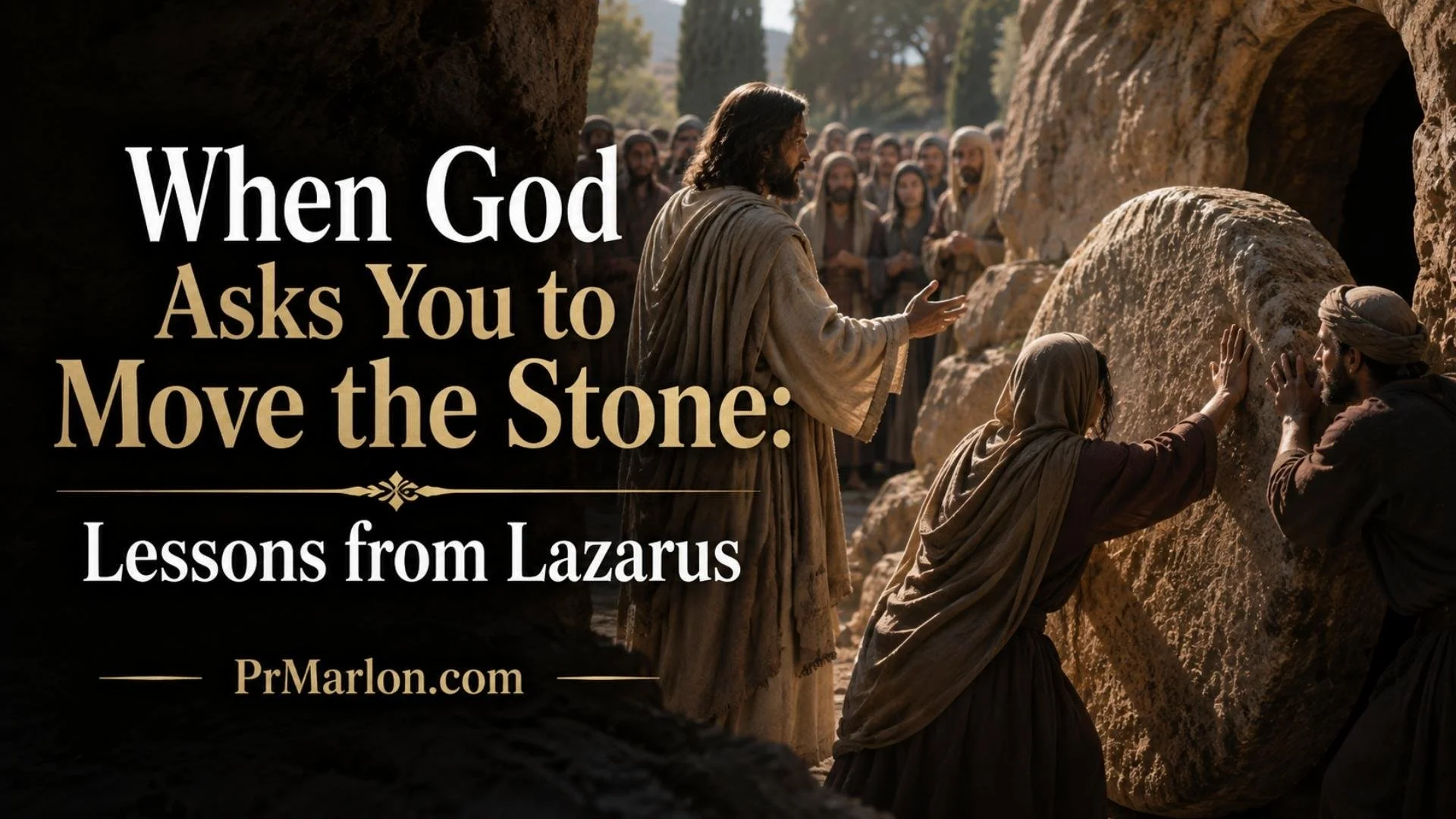
Jesus said, “Take away the stone.”
Martha, the sister of him who was dead, said to Him, “Lord, by this time there is a stench, for he has been dead four days.”
—John 11:39 NKJV
Do you find it odd that Jesus asks them to remove the stone? If God can do anything, why should those present have to take away the stone?
I once heard a version of this from a young man. He had graduated from college and moved back in with his parents. He did not have a job and had gotten tired of applying for jobs. So he stayed home and played video games. I don’t know the emotional struggles he was facing, but what surprised me was his theological reason for not applying. He told me he was praying for a job and believed with all his heart that God could give him a job and would give him the right job at the right time.
I was shocked by this theological statement. I did not expect it. What should I say as his pastor?
Did I doubt God’s ability to give this young man a job?
Was my faith weaker than his?
Did this young man have greater faith?
Or was he using faith as an excuse to prioritize comfort over action?
Was faith his excuse to hide behind fear of rejection and failure?
Could it be that in life we fail to see the miracle God wants to perform because we fear the stench obedience will cause?
Could it be that sometimes we use faith as an excuse not to do the things God has actually placed within our responsibility? Are we waiting for God to do what He has asked us to do?
Martha, introduced here as “the sister of him who was dead,” made solid arguments against the removal of the stone. It had already been four days, and there would be a stench. I would add that moving the stone required considerable physical effort from multiple people. It would take volunteers and coordination. Let’s imagine the scene and think through it together. The hole in the rock, the entrance to the cave, had to be large enough for them to carry a full-grown adult male inside. We are not told of the dimensions, but it is safe to say it was not a small hole. A stone large enough to cover that hole would be heavy. Taking away such a large stone is inherently dangerous. Bruises, scrapes, crushed toes, herniated disks, backs thrown out, crushed fingers. Was the crowd present wearing their closed-toe sandals? Did they wear their robes for heavy lifting?
I may be turning a small detail in the story of Lazarus into a big one, but Jesus’ command for those present to take away the stone is the story I used to illustrate God’s desire to involve us, even when our contribution is inadequate to solve the problem completely. Jesus could have moved the stone Himself or asked angels to do it for Him; but He commanded those present to do it, giving them a role in the miracle He was about to perform. All the best, strongest, and brightest people in the world could not bring Lazarus back to life, but those present could work together and move the stone. The way I see it, we do not have to bring the dead to life, but we should be willing to move the stones Jesus wants us to move, trusting Him to do what we could never accomplish on our own.
Could God give that young man the job while he sat at home and played video games? Sure. But I find it even more likely that the young man would find a greater blessing and growth by going out every day and applying for every job he could, as he anticipated God’s blessings. Oftentimes, it is not just about getting what we want, but also the growth that happens on the journey.
If you would believe
Jesus said to her, “Did I not say to you that if you would believe you would see the glory of God?”
—John 11:40 NKJV
One of the key points of John 11 and the story of Lazarus is faith/belief. In verse 15, Jesus said He was glad He was not there to heal Lazarus, so the disciples may believe. In verse 25, Jesus asked Martha if she believed that He was the resurrection and the life. Martha said she believed; now she would see the glory of God. The point is belief, but not only in what Jesus can do, but ultimately, in who He is.
Jesus prays
Then they took away the stone from the place where the dead man was lying. And Jesus lifted up His eyes and said, “Father, I thank You that You have heard Me. And I know that You always hear Me, but because of the people who are standing by I said this, that they may believe that You sent Me.”
—John 11:41-42 NKJV
Jesus prays aloud so others may hear and believe that the Father sent Jesus. Jesus’ prayer was for our benefit. God allowed Lazarus to die, but the story did not end in death. Jesus used this apparently hopeless situation to reveal His glory and cause others to believe who He really was: the Messiah, the Christ, the Son of God sent by God to us.
Lazarus come forth
Now when He had said these things, He cried with a loud voice, “Lazarus, come forth!”
—John 11:43 NKJV
I love how Jesus had to specify that He was calling Lazarus to come forth. The Bible describes the resurrection as taking place as a result of Jesus’ mighty shout.
For the Lord Himself will descend from heaven with a shout, with the voice of an archangel, and with the trumpet of God. And the dead in Christ will rise first.
—1 Thessalonians 4:16 NKJV
One day Jesus will come again and awaken the dead with a mighty shout. The same voice that called Lazarus by name and brought him back to life will one day call all those who sleep in Jesus, and the dead in Christ will rise first.
Loose him
Lazarus heard and responded.
And he who had died came out bound hand and foot with graveclothes, and his face was wrapped with a cloth. Jesus said to them, “Loose him, and let him go.”
—John 11:44 NKJV
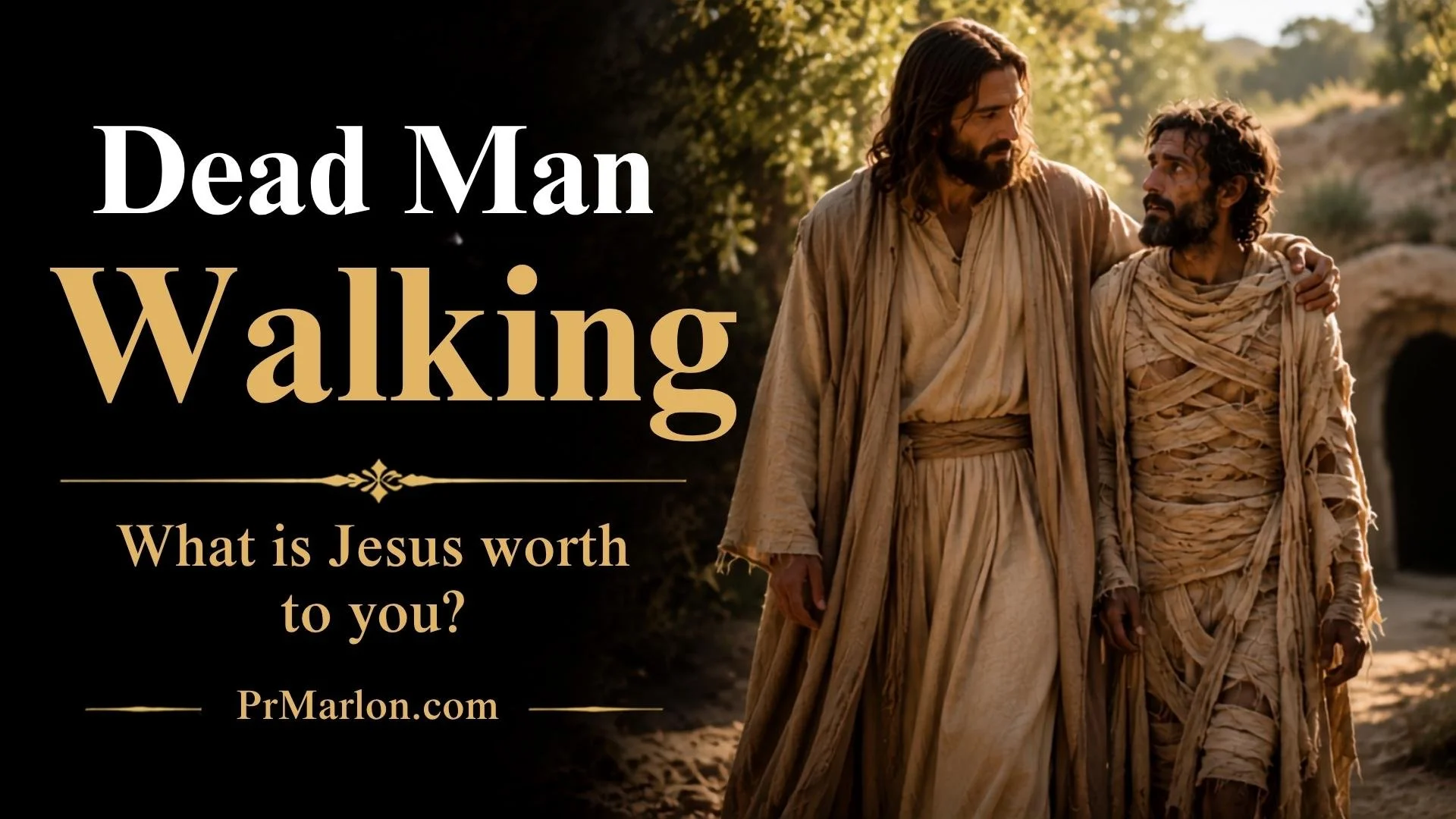
I imagine Lazarus walking out wrapped in graveclothes, looking like the mummies I saw in cartoons as a kid. Arms stretched forward, trying to walk with great difficulty. Those watching must have been so shocked they stood there dumbfounded, and Jesus had to command them to go to Lazarus and loosen his graveclothes. Just because we can’t raise the dead, it doesn’t mean God has no purpose for us. Jesus commanded those present to remove Lazarus’ graveclothes. They were to help Lazarus enjoy greater freedom in the new life Jesus had given him.
We cannot convert hearts; only God does that. But we can walk alongside those God has converted. We can be a community that helps, encourages, and disciples one another. Only the Holy Spirit can convict and transform a heart, but we can be a nurturing community in that journey.
Practical application
No situation is hopeless when Jesus is involved. We may not understand the timing. We may not understand why He asks us to move a stone. It may all seem hopeless; Lazarus had been dead for four days, and there was a stench. But Jesus is our hope; Jesus is the resurrection and the life. Jesus is our victory. We may become frustrated and feel helpless in the situations we face, but our human limitations and frustrations should remind us of our need for God and His promises. This does not mean frustrations magically disappear, but that we face them trusting in Jesus. Martha, Mary, and everyone present were altogether unable to bring Lazarus to life. But Jesus did not ask them to resurrect Lazarus; He only asked them to remove the stone and, later, loosen his graveclothes. They could do those things; for the rest, they trusted in Jesus.
Jesus does not ask us to accomplish what only He can accomplish.
He asks us to be faithful in what He gives us to do.
The people could move the stone; they could not raise the dead. We can become so discouraged when we consider our many limitations and weaknesses. Let us focus on Jesus and on what He promises to do. All the glory goes to God. Jesus is the answer. He is not just someone who can raise the dead; He is the resurrection and the life! The answer is not just a favorable outcome to our situation; the answer is a personal relationship with a loving God. Because if you believe that Jesus is the life and the resurrection, then no situation is ever hopeless, not even death.
Footnotes:
What emotion was Jesus experiencing?
The word in question is ἐμβριμάομαι (embrimaomai)
The NIV translates it as Jesus being “deeply moved,” while the New Living Translation says Jesus was “still angry.” The Holman Christian Standard Bible says Jesus was “angry in Himself,” and Smith’s Literal Translation says Jesus was “heavy in Himself.” This variation among Bible translations shows the word is not easy to translate. In this case, it does not have a significant theological impact in the story. Though it is challenging to know what exactly Jesus was experiencing emotionally (the same word was used in John 11:33), it is abundantly clear that Jesus was experiencing this deeply.
We also struggle with death; we feel all kinds of emotions, and experiencing those emotions is not sinful. Death is an enemy. Jesus knew that He was the life and the resurrection; He knew what He was about to do, yet He experienced the emotional toll death causes. Likewise, we can have full confidence in Jesus and have a deep emotional response to the death of a loved one.
Grave site:
The grave site briefly described in v. 38 conforms to many of the tombs that can still be seen in that vicinity. Such sites were usually formed from hollowed out caves, some of which would have multiple horizontal or vertical vaults dug out from the main chamber. Each vault would generally be covered by a flat stone slab that sealed the grave. The entrance to this type of a tomb-chamber normally was closed by a large circular stone that rolled across the entry in a stone trough. This type of tomb apparently served not only the body of Lazarus but also that of Jesus (cf. 19:41–20:1–12).
—Gerald L. Borchert, John 1–11, vol. 25A, The New American Commentary (Nashville: Broadman & Holman Publishers, 1996), 362.
Personal Speculation:
When Jesus calls Lazarus back to life, He specifically calls Lazarus by name. I imagine that if Jesus had not specified that He was calling Lazarus, other dead people within earshot of His voice would also have come back to life. (This is just a theory; I don’t know what constitutes “earshot” for the dead.) This is not a major theological point, but something I wonder about.