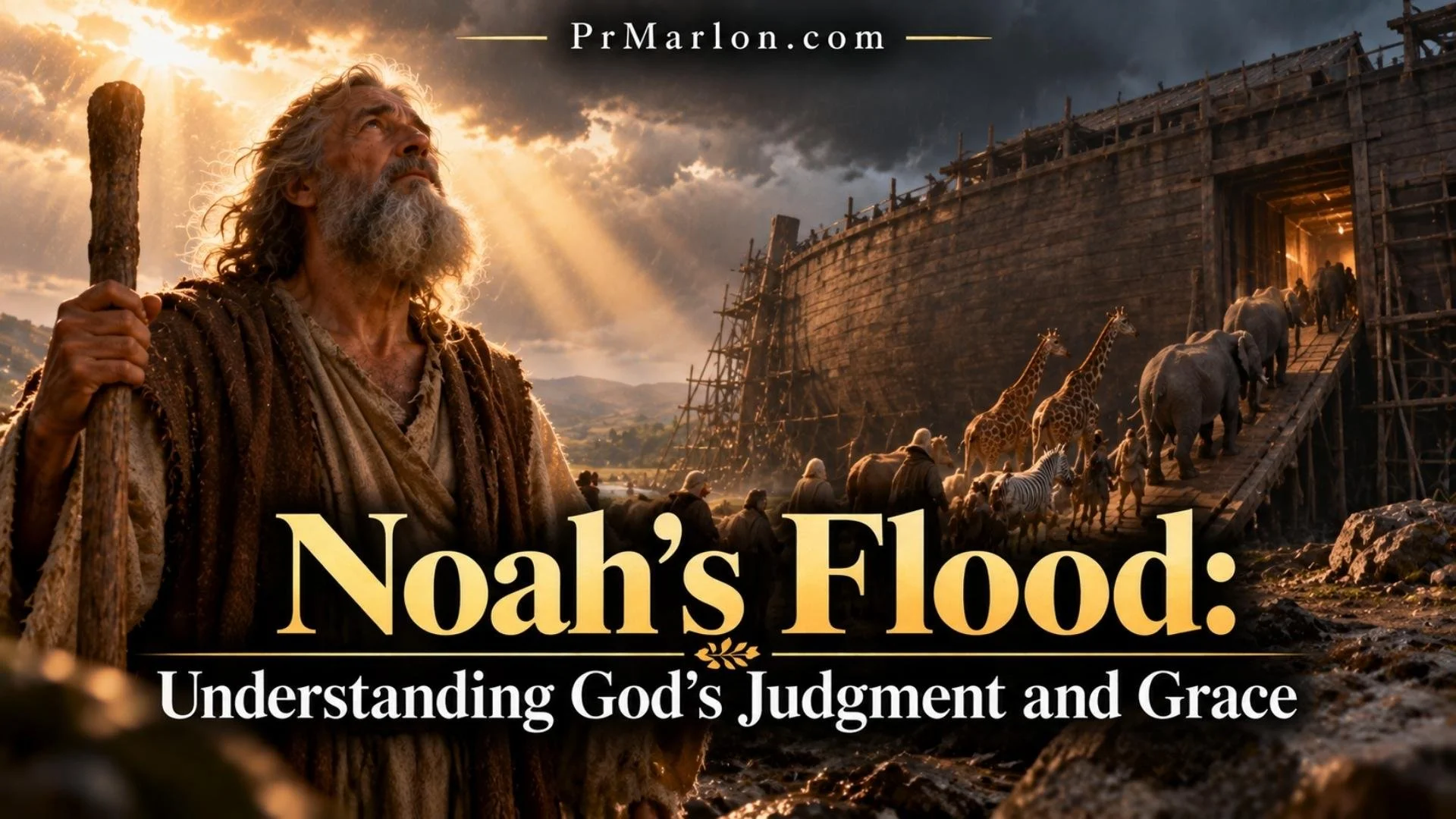
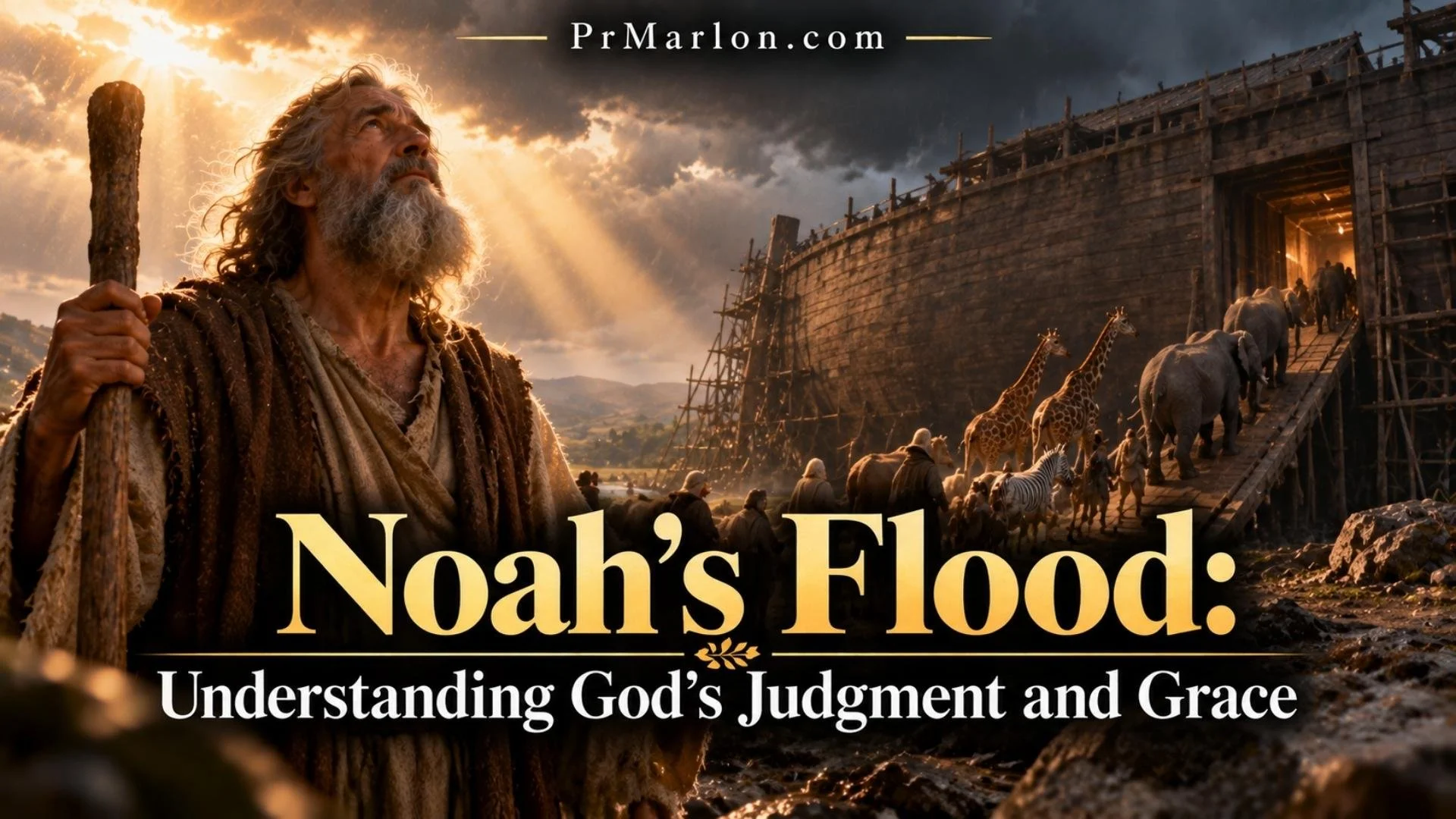
Noah's Flood: Understanding God's Judgment and Grace
The Flood in Genesis: God's Judgment, Grace, and Mercy
How can a loving God destroy the world?
It’s one of the hardest questions the Bible raises, and the flood is where it feels most pressing. Yet the first time the word grace appears in Scripture, it doesn’t appear in a story about blessing. It appears in the middle of a story about judgment: “But Noah found grace in the eyes of the LORD” (Genesis 6:8).
This is part 4 of my Investigating Judgment series, where I look at biblical stories of judgment to better understand salvation and, ultimately, the heart of God. In Genesis 6, we’ll see that God’s judgment is not evidence that He has stopped loving humanity. It is His response to the corruption, violence, and suffering that sin produces.
Now it came to pass, when men began to multiply on the face of the earth, and daughters were born to them, 2 that the sons of God saw the daughters of men, that they were beautiful; and they took wives for themselves of all whom they chose.
—Genesis 6:1-2 NKJV
There are several interpretive challenges in the first few verses of Genesis 6. I discuss these in greater detail in my post “Who Were the Sons of God in Genesis 6? Three Interpretations Explained.” The challenge lies in identifying the “sons of God.” Three different views have been entertained from the very earliest times: the “sons of God” being regarded as the sons of princes, angels, the Sethites or godly men; and the “daughters of men,” as the daughters of people of the lower orders, of mankind generally, of the Cainites, or of the rest of mankind as contrasted with the godly or the children of God. (For a deeper dive, see Carl Friedrich Keil and Franz Delitzsch, Commentary on the Old Testament, vol. 1 (Peabody, MA: Hendrickson, 1996), 81.)
I believe the strongest biblical evidence supports interpreting the “sons of God” as the Sethites, or godly men. Here is a summary of this view.
The idea of the phrase “sons of God” was used in connection with Israel (Deut. 14:1; Hos. 1:10; 11:1), and the teaching of subsequent Scripture is perfectly clear against the inter-marriage of Israel with the Canaanites. Besides, this verse accounts for the universality of the sin which led to the catastrophe of the Flood, and verse 3 declares God’s sentence upon man only for the sin recorded in verse 2. Surely angels would have been included in the judgment and in the record if they had been involved in this sin.
—W. H. Griffith Thomas, A Devotional Commentary: Genesis (Grand Rapids, MI: Wm. B. Eerdmans Publishing Company, 1946), 66.
The LORD said…
And the Lord said, “My Spirit shall not strive with man forever, for he is indeed flesh; yet his days shall be one hundred and twenty years.”
—Genesis 6:3 NKJV
Previously, the divine word caused creation (Genesis 1:3), and now it will negate it. Sin has impacted God’s connection with His creation. The creation account begins with the Spirit of God hovering over the face of the waters (Genesis 1:2b), and now humanity has multiplied over the face of the earth (Genesis 6:1); yet despite these connections, we now have a reversal, with the Spirit of God being removed. The connection goes deeper when you consider that the Hebrew word rûaḥ רוּחַ means wind, breath, mind, spirit. It is used in Genesis 1:2 and 6:3 as a reference to God’s Spirit and in passages like Psalm 104:29-30 as breath needed for life and as God’s spirit that creates and maintains life (see Job 26:13; 33:4). We will revisit this in Genesis 6:17.
God’s Spirit will not strive with humanity forever. Interestingly, the word strive (dîn דִּין) means to judge, contend, and plead. In the context of judgment, this word can be used in the sense of pleading. An example appears in Jeremiah 30:13. The same word can also mean to judge in favor (Jeremiah 22:16). The divine pleading grace does not last forever.
120 years?
After indicating that humanity will experience a curtailed life span, Genesis 6:3 specifies the term limit as “a hundred and twenty years,” a greatly diminished number compared to the antediluvians (Genesis 5). But, it may be argued, postdiluvian men among the Shemites (Genesis 11:10–32) live longer than 120 years, as do the patriarchs (Abraham lived for 175 years (Genesis 25:7)). Therefore, some interpret the 120 years as a period of grace before the flood. Jewish tradition understood the 120 years as an opportunity for repentance (cf. Tg. Onq.; Pirke Aboth 5:2; cf. 1 Peter 3:20).
By analogy, the Babylonian flood story Atrahasis depicts periods of twelve hundred years between the various attempts of the gods to destroy humanity. Since Genesis and the Babylonian story have the same sequence of events (creation, increasing population, flood), this 120 years may be intended as such a break. Furthermore, it is argued, the threat of God’s judgment anticipates an approaching event; hence, the 120 years as a prologue to the flood correlates well. (K. A. Mathews, Genesis 1-11:26, vol. 1A, The New American Commentary (Nashville: Broadman & Holman Publishers, 1996), 334–335.)
Nephilim?
There were giants on the earth in those days, and also afterward, when the sons of God came in to the daughters of men and they bore children to them. Those were the mighty men who were of old, men of renown.
—Genesis 6:4 NKJV
The next interpretive challenge concerns the identity of the Nephilim, a word that only shows up in two places in the entire Old Testament, Genesis 6:4 and Numbers 13:33. Some translate it as “giants,” a reading from the Septuagint (LXX), the Greek translation of the Hebrew Scriptures or Old Testament. This is likely due to the use of the same word, nephilim, in Numbers 13:33. If the nephilim in both passages are of the same origin, it would mean that they somehow survived the flood along with Noah and his family. However, this interpretation would run counter to the sense of the biblical story, as we will see later in this post. The term nephilim derives from the root naphal, meaning “fall.” In this case, a better translation would be “fallen ones” rather than giants. This reference to their moral degradation fits the story and themes of the surrounding chapters and the rest of the Bible. "Mighty men” also refers to their violent character (see Psalms 52:3-5; 120:2-4), which also fits the recent portrayal of the Cainites (Genesis 4:23-24). I do a deeper dive into the interpretive challenges of the term “nephilim” in my post “Who Were the Nephilim?”
The LORD saw
5 Then the LORD saw that the wickedness of man was great in the earth, and that every intent of the thoughts of his heart was only evil continually. 6 And the LORD was sorry that He had made man on the earth, and He was grieved in His heart. 7 So the LORD said, “I will destroy man whom I have created from the face of the earth, both man and beast, creeping thing and birds of the air, for I am sorry that I have made them.”
—Genesis 6:5-7 NKJV
The line “then the LORD saw” is also reminiscent of the creation account where we read, “and God saw that it was good” (Genesis 1:10). But in Genesis 6 we read that the LORD saw that the wickedness of humanity was great in the earth. In the creation account, God saw and judged or determined that what He had created was good and even “very good” (Genesis 1:31). This time God sees, and what He sees is not good, but wicked, bad, evil, the opposite of good.
The wickedness was not partial. God saw not at a glance, but with careful observation. God observed enough to determine that not only was human wickedness great on the earth, but also that every intent of the thoughts of the human heart was only evil continually. This broke God’s heart.
Here we see a drastic contrast. The hearts of the antediluvians were consumed with evil thoughts, and God’s heart is wounded and filled with pain. God’s reaction to human depravity is to grieve.
God’s response of grief over the making of humanity, however, is not remorse in the sense of sorrow over a mistaken creation; our verse shows that God’s pain has its source in the perversion of human sin. The making of “man” is no error; it is what “man” has made of himself.
—K. A. Mathews, Genesis 1-11:26, vol. 1A, The New American Commentary (Nashville: Broadman & Holman Publishers, 1996), 343.
Have you ever considered that we are not the only ones who suffer because of sin? Have you pondered how a loving God feels when He watches sin and suffering, wickedness, evil, and pain? When we study judgment, we have to pay special attention to what it reveals about the heart of God. Consider God’s perspective in all of this. Psalm 78 gives us an important perspective on how rebellious human behavior provokes and grieves God.
40 How often they provoked Him in the wilderness,
And grieved Him in the desert!
41 Yes, again and again they tempted God,
And limited the Holy One of Israel.
42 They did not remember His power…
—Psalm 78:40-42a NKJV
Yet, in this context of sin, wickedness, death, and grief, we find hope.
But… grace
But Noah found grace in the eyes of the LORD.
—Genesis 6:8 NKJV
Just when it seems like all hope is lost, God is gracious and spares Noah. The word “grace” occurs here for the first time in Scripture, and clearly has the same meaning as in the NT references, where the merciful, unmerited favor of God exercised toward undeserving sinners is described. How deeply God loved humanity even in their fallen state can be observed from a number of factors.
He gave them a gospel of mercy, in the promise of the woman’s seed. (Genesis 3:15; 4:25-26; 5)
A ministry of mercy, by raising up and maintaining a succession of pious men and women to preach the gospel and warn them against the ways of sin. (Genesis 4:25-26; 5)
A spirit of mercy to strive and plead with them. (Genesis 6:3)
A providence of mercy, by measuring out to them a long probationary period of time. (Genesis 4:13-24; 6:1-7)
And finally, an example of mercy, by saving the righteous when all others were destroyed. (Genesis 6:14-22)
This ancient example of grace and mercy is a source of assurance and hope for believers who live at the end of time. If you think this is a stretch, consider that Christ Himself compared the end of days to Noah’s age (Matthew 24:37–39). His loyal followers can rest assured that God will accept them as He accepted Noah, and will likewise preserve them amid the evil of this day, and provide for their safety in the coming judgment. (Francis D. Nichol, ed., The Seventh-Day Adventist Bible Commentary, vol. 1 (Review and Herald Publishing Association, 1978), 252.)
What was Noah like?
9 This is the genealogy of Noah. Noah was a just man, perfect in his generations. Noah walked with God. 10 And Noah begot three sons: Shem, Ham, and Japheth.
11 The earth also was corrupt before God, and the earth was filled with violence. 12 So God looked upon the earth, and indeed it was corrupt; for all flesh had corrupted their way on the earth.
—Genesis 6:9-12 NKJV
Notice that there is no clear antecedent act of righteousness by Noah that explains his favored standing before God. The textual evidence points to a personal relationship with God that shaped his character, rather than specific acts of obedience performed to earn God’s favor. The secret to Noah’s life was not a list of good deeds, but rather the fact that he walked with God.
If you find yourself tempted to keep lists of good deeds and compare yourself to others, I encourage you to shift your focus to a daily experience of communion with God. Just walk with God each day. Choose God throughout your day. Invite Him into every aspect of your life. Fall in love with God, even when it seems like everyone else has walked away from Him. Noah is not described as sinless, but just. Some translations say “perfect,” and some may want to read that as sinless, but the Hebrew word is tāmîm תָּמִים, meaning complete, whole, entire, sound, having integrity, blameless. The text is not saying Noah never made mistakes, but rather that he was not rebellious against God. Genesis 6:22 points out Noah’s obedience, which makes sense for someone who loves God and walks with Him.
Here is how the writer of Hebrews puts it.
By faith Noah, being divinely warned of things not yet seen, moved with godly fear, prepared an ark for the saving of his household, by which he condemned the world and became heir of the righteousness which is according to faith.
—Hebrews 11:7 NKJV
Walking with God is pretty incredible. But not only did Noah walk with God, but he also did it when the earth was filled with violence. When all flesh had corrupted their way on the earth.
Filled with violence.
And God said to Noah, “The end of all flesh has come before Me, for the earth is filled with violence through them; and behold, I will destroy them with the earth.
—Genesis 6:13 NKJV
As we explored in my post on Genesis 4, innocent blood cries out to God, demanding judgment. It is worth noting the word for destroy, šāḥaṯ שְׁחַת, in this verse because it sheds light on what God is doing, especially when read alongside the previous verse.
12So God looked upon the earth, and indeed it was corrupt (šāḥaṯ); for all flesh had corrupted (šāḥaṯ) their way on the earth.
13And God said to Noah, “The end of all flesh has come before Me, for the earth is filled with violence through them; and behold, I will destroy (šāḥaṯ) them with the earth.
I added the original word along with the English translation to point out an important point. When God says that He will destroy them along with the earth, He is saying that He will give them what they have chosen. The people have chosen corruption; they have corrupted themselves, and God is giving them over to corruption. God is giving them what they have chosen for themselves and each other. God is giving the earth and its inhabitants an intense and global version of what they have repeatedly chosen for themselves.
What is the loving thing to do? Love is more complex than simply letting people do whatever they want. God cannot simply stand by and watch all the pain and suffering and violence that is taking place as a result of humanity rebelling against him and choosing corruption (šāḥaṯ). Love seeks the good of others, protects the vulnerable, and takes wrongdoing seriously.
Judgment is not only about what God does to the wicked; it is also about what He does for those suffering under wickedness. The flood narrative presents a world filled with violence, not merely a world in which people privately hold incorrect beliefs. God's patience should not be confused with indifference. Allowing violence to continue indefinitely is not morally neutral, especially for its victims. God grieved over what humanity had become, gave them a period of warning, and ultimately acted against the violence that had overtaken the earth.
For the sake of brevity, I will skip over the verses describing the construction of the ark (Genesis 6:14-16)
Floodwaters
17 And behold, I Myself am bringing floodwaters on the earth, to destroy from under heaven all flesh in which is the breath of life; everything that is on the earth shall die. 18 But I will establish My covenant with you; and you shall go into the ark—you, your sons, your wife, and your sons’ wives with you. 19 And of every living thing of all flesh you shall bring two of every sort into the ark, to keep them alive with you; they shall be male and female. 20 Of the birds after their kind, of animals after their kind, and of every creeping thing of the earth after its kind, two of every kind will come to you to keep them alive. 21 And you shall take for yourself of all food that is eaten, and you shall gather it to yourself; and it shall be food for you and for them.”
22 Thus Noah did; according to all that God commanded him, so he did.
—Genesis 6:17-22 NKJV
Though it might seem harsh, the biblical text is clear. God is the one bringing the floodwaters on the earth to destroy all flesh in which is the breath (rûaḥ רוּחַ; see my comments above on v.3). According to this verse, everyone who was not in the ark died. The biblical account makes no room for any humans outside the ark to survive, and this is an important point. The flood was not just a regional storm that hit the Middle East, and anyone with a boat survived, or perhaps those living far away also survived. The judgment is upon all the earth, and God says that the floodwaters will destroy all flesh in which there is breath of life; everything that is on the earth shall die, and that salvation was only available in the ark that Noah was going to build according to the specifications God gave him.
Takeaway
Each judgment story in this series has taught us something about God and about salvation, and the flood continues the pattern. Before God acts, He looks. With Adam and Eve and with Cain, He came and spoke with them personally. In Genesis 6, He sees, carefully and deliberately, that human wickedness is great and that every intent of the heart is only evil continually (Genesis 6:5).
But as God looks, we discover something else. Noah found grace in the eyes of the LORD. The Hebrew word is ḥēn חֵן, and the Septuagint translates it with charis χάρις, the same word the New Testament uses for grace. The first mention of grace in the Bible comes in the middle of a judgment story. In the Bible, judgment is not God searching for a reason to condemn. It is God confronting what is destroying His creation while making a way for sinners to be saved.
That doesn’t make this an easy story. The destruction of human life is sobering, and we shouldn’t minimize it. But Genesis shows us a God whose patience is not indifference, whose grief reveals His heart, and who takes the victims of violence seriously enough to act. Love is more complex than simple permissiveness.
The story of the flood also serves as a prototype for the final day of judgment. Jesus mentions this in Matthew 24:37-38, and we also read it in 2 Peter 3:3-7. Just as Noah was saved by grace, so will those living in the last days of earth’s history. Also, just like God judged the ancient world because of its evil and violence, He will once again judge the earth, but this time with fire.
Call to action
Regardless of how others are living around us, we are called to walk with God as Noah did. The flood reminds us that God’s love is neither indifferent to evil nor eager to destroy. He grieves over corruption, extends grace, provides a way of escape, and confronts the violence that destroys His creation. Our faithfulness shouldn’t depend on how others are living but on our own desire to follow Him and live for Him.